


The Agency Workers Regulations 2010, often called AWR, are a crucial piece of legislation for any temporary worker in the UK. At its heart, it’s all about fairness. The core idea is simple: after working in the same role for 12 weeks, you should get the same basic pay and working conditions as the permanent staff you're working alongside.
This guide will walk you through what this means in practice, especially for those who are contracting in business. We will explain how the qualifying period works, what rights you have from day one, and how to ensure you receive what you are owed.
A Guide to the Agency Workers Regulations 2010
If you're a contractor or temporary worker in the UK, understanding the Agency Workers Regulations 2010 is essential. This is not just bureaucratic red tape; it is legislation that protects your rights and ensures you are treated fairly.
Think of AWR as a two-stage guarantee. Some rights kick in from the moment you walk through the door on day one. Others, the more significant ones related to pay and holidays, unlock after a qualifying period. Let’s break down what that means for you.
Your Rights From Day One
You are entitled to certain rights from your very first day on an assignment. These "Day One Rights" ensure you are properly integrated into the workplace and not treated as an outsider.
These rights include:
- Access to shared facilities. This could be the staff canteen, a childcare area, or the car park. If permanent staff can use it, so can you.
- The right to be told about internal job vacancies. This gives you a fair opportunity to apply for permanent roles, just like anyone else in the organisation.
These entitlements are for all agency workers, regardless of whether you are paid via an umbrella company or a different arrangement.
Understanding the 12-Week Qualifying Period
This is the big one. The 12-week qualifying period is the real game-changer in the AWR. Once you have been in the same role, with the same client, for 12 consecutive calendar weeks, your rights expand significantly.
You become entitled to parity on key conditions:
- Pay: This is not just your basic hourly or daily rate. It includes things like overtime, shift allowances, and certain types of bonuses.
- Working Time: You cannot be expected to work longer hours than your permanent colleagues.
- Rest Periods: You get the same daily and weekly rest breaks.
- Annual Leave: Your holiday entitlement should match that of a comparable permanent employee.
Here's a quick look at how your rights evolve.
Your AWR Rights at a Glance: Day One vs After 12 Weeks
| Entitlement | Rights from Day One | Rights After 12 Weeks |
|---|---|---|
| Pay | Standard contractual rate. | Equal pay, including overtime, bonuses, and allowances. |
| Annual Leave | Statutory minimum (28 days pro-rata). | Equal to the hirer's permanent staff (if more generous). |
| Working Hours & Rest Breaks | Statutory limits apply. | Equal to the hirer's permanent staff. |
| Access to Facilities | Full access to canteens, parking, etc. | Full access continues. |
| Internal Job Vacancies | Right to be informed of vacancies. | Right to be informed continues. |
The Agency Workers Regulations 2010 officially came into effect on 1 October 2011, changing the landscape for how UK businesses use temporary staff. For a deeper dive into their initial impact, legal organisation Mayer Brown shared valuable insights at the time.
How The 12-Week Qualifying Period Works
The 12-week qualifying period is the heart of the Agency Workers Regulations 2010. Think of it as a crucial milestone. Once you have worked in the same role, for the same client, for 12 continuous calendar weeks, you unlock a new set of rights that put you on a much more even footing with their permanent staff.
It is a bit like an apprenticeship in fairness. For the first 12 weeks, you get your basic Day One rights. But the moment you cross that 12-week line, you are entitled to ‘equal treatment’ on the core conditions of your job. For many contractors, this is a total game-changer.
Understanding Equal Treatment After 12 Weeks
So, what does "equal treatment" actually mean in practice? It is about creating parity between you and a ‘comparable’ permanent employee at the client’s company, someone doing the same, or at least broadly similar, work as you.
Once you hit that 12-week mark, your entitlements must match theirs in several key areas:
- Pay: This is not just your basic rate. It covers any fees, bonuses, commission, and overtime pay directly tied to the work you do.
- Working Hours: You should not be expected to work longer hours than a permanent counterpart.
- Night Work: If permanent staff get better pay or conditions for night shifts, you must get them too.
- Breaks and Rest: You're entitled to the same daily and weekly rest periods.
- Annual Leave: Your holiday allowance must match that of the hirer's direct employees, which is often more generous than the statutory minimum.
When these regulations came in, they made quite a splash. Hirers suddenly had to factor in the extra cost of engaging temporary workers beyond the 12-week point, as their permanent staff often earned more than their agency equivalents.
This infographic lays out the timeline of your rights perfectly.
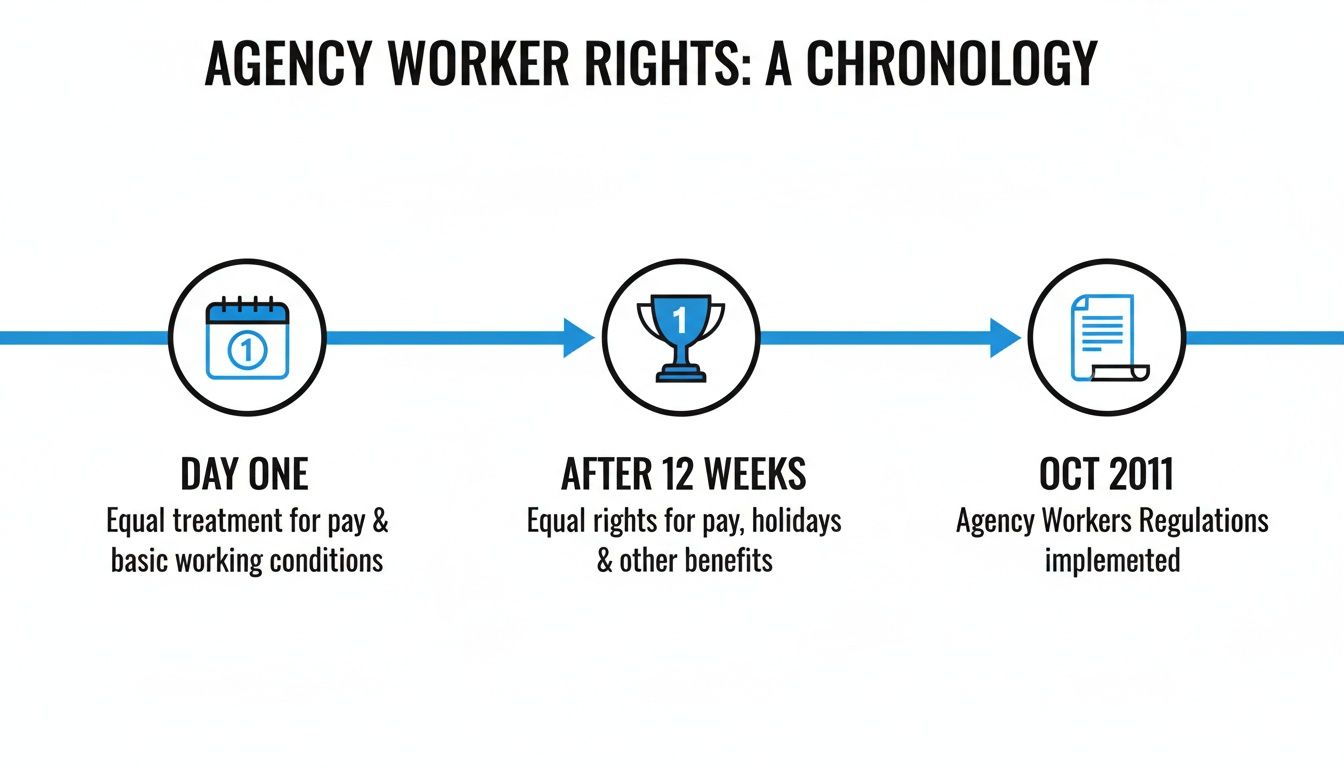
As you can see, there is a clear path from the basic rights you get on day one to achieving full equal treatment after the qualifying period.
How Is The 12-Week Period Calculated?
The 12-week clock starts ticking on your first day in a particular role. A week counts as any calendar week you work, even if it is just for an hour. The key is that the period needs to be continuous, but the rules allow for certain breaks that will not send you back to square one.
It is vital to monitor this yourself. If your pay rate suddenly increases after 12 weeks, you will see it on your payslip. Getting to grips with these documents is a crucial skill, and our guide on how to read a UK payslip can help you make sense of it all.
Continuity is everything. The regulations are designed to count 12 consecutive calendar weeks in the same role. This ensures that temporary workers who are committed to a role get the fair treatment they deserve, and short, reasonable interruptions do not break that continuity.
What Happens If There Is a Break in Your Assignment?
Not all breaks in your assignment are equal. Some will simply ‘pause’ the 12-week clock, while others will break the chain completely and reset it to zero.
The clock resets to zero if:
- You start a new role with the same client that is substantively different. This means the work, skills, and responsibilities have fundamentally changed.
- There's a gap of more than six calendar weeks between assignments in the same role.
The clock pauses for certain types of breaks, picking up where you left off when you return. These include:
- Any break of six calendar weeks or less.
- Time off for sickness or injury (for up to 28 weeks).
- Any period you take as annual leave.
- Breaks for jury service (for up to 28 weeks).
- Any break caused by a planned workplace shutdown, like over the Christmas period.
- Pauses resulting from industrial action.
Understanding how these different breaks affect your qualifying period is essential. It means you can accurately track when your enhanced rights are due and confidently raise it with your agency when the time is right.
Navigating AWR as an Umbrella Company Contractor
When you work through an umbrella company, it's easy to wonder how the Agency Workers Regulations 2010 (AWR) fit into the picture. After all, the umbrella is your legal employer, handling your PAYE, National Insurance, and statutory rights like sick pay. Does that mean your AWR rights disappear?
Absolutely not. AWR creates a 'chain of responsibility'. Even though we, as your umbrella employer, manage the payroll side of things, the recruitment agency and the end-client still have direct legal duties to you under AWR.
This setup ensures you get the protections the regulations were designed for, without anything falling through the cracks.
The Chain of Responsibility Explained
Think of it as a three-way partnership where everyone has a specific job to do to keep things compliant. It is a shared effort.
Here is a simple breakdown of who does what:
- You (The Contractor): Your main role is to track how many weeks you have been in a single role. If you hit the 12-week mark and think your rights are not being met, it is up to you to raise it with your agency.
- The Recruitment Agency: The agency acts as the central hub. They must talk to the end-client to find out what comparable permanent staff earn and what their working conditions are. It is their job to ensure your pay rate is correctly adjusted after 12 weeks.
- The End-Client (The Hirer): The client has to give the agency accurate information on their internal pay scales and benefits. They are also responsible for your 'Day One' rights, like access to the canteen or news about internal job openings.
- The Umbrella Company: Our job at UmbrellaCompany.com is to process your pay accurately based on the rate the agency gives us. When the agency tells us your rate has been uplifted because of AWR, we make sure that new rate is reflected on your payslip, with all the correct tax and NI deductions.
This structure means that if your right to equal pay is being ignored, the liability usually sits with the agency and the hirer, as they hold the key information needed to ensure parity. Many contractors appreciate the clarity an umbrella provides; find out more in our guide on using an umbrella company for freelancers.
The End of the Swedish Derogation
For years, a loophole known as the 'Swedish Derogation' (or 'pay between assignments') existed. It allowed agencies to sidestep the 12-week equal pay rule if they gave a worker a permanent contract and paid them a small amount between jobs.
This was widely seen as a way to get around the spirit of the AWR. Thankfully, the Swedish Derogation was officially abolished in the UK on 6 April 2020.
This was a massive win for contractors. Its repeal means that all agency workers are now entitled to equal pay after completing the 12-week qualifying period, no matter what their contract says. The loophole is closed for good.
This change strengthened the core principle of the agency workers regulations 2010: equal treatment for all. It simplifies the landscape and gives you greater certainty about your rights. As an umbrella company employee, you are fully protected by this, guaranteeing you get pay parity on every qualifying assignment.
Spotting and Preventing AWR Avoidance

The Agency Workers Regulations 2010 were designed with real teeth. A crucial part of this is the powerful 'anti-avoidance' provisions, which are there to stop hirers or agencies from deliberately engineering ways to get around the 12-week qualifying period.
These rules exist for a simple reason: without them, some might be tempted to structure assignments just to deny contractors their right to equal pay and conditions. Knowing what these tactics look like is your first line of defence.
Common Avoidance Tactics to Watch For
While most agencies and hirers play by the rules, it pays to know the red flags. Certain patterns could signal a deliberate attempt to reset your 12-week qualifying clock before you can gain your AWR rights.
Keep an eye out for these scenarios:
- The ‘Role-Hopping’ Game: You are moved between roles at the same company that seem only slightly different on paper. If your core duties are the same, this could be a dubious attempt to claim it's a "substantively different" role just to reset your clock.
- Structured Breaks: Your assignments are consistently cut short just before you hit the 12-week mark, say at week 10 or 11. You are then offered a new contract for the exact same role a few weeks later, forcing you to start the count again.
- Using Multiple Agencies: A hirer might use different agencies to supply you for the same role, ending one contract at week 11 and immediately starting another. The rules are clear: your qualifying period is tied to the role and the hirer, not the agency, so this tactic is not compliant.
Working with an accredited, compliant provider gives you an extra layer of protection. It is always worth checking you are partnered with a business that takes fair and legal practices seriously, like an FCSA-accredited umbrella company.
The Power of the Anti-Avoidance Provisions
The law is clear on this matter. The anti-avoidance measures are specifically designed to penalise any hirer or agency that tries to manipulate assignments to sidestep the 12-week qualifying period.
If an employment tribunal spots a pattern of assignments that looks like the main goal was to dodge your AWR rights, it can step in. The regulations give it the power to issue a special award against the hirer or agency.
The regulations contain specific anti-avoidance mechanisms to prevent circumvention of the 12-week qualifying period through structural manipulation of assignments. If a pattern of assignments suggests an attempt to avoid these requirements, agency workers are entitled to be treated as if they had completed the 12-week threshold, with potential fines up to £5,000 for the agency, hirer, or both. Discover more insights at Employment Law Worldview.
This financial penalty is a serious deterrent. It sends a clear signal to everyone in the supply chain that trying to game the system is a risk that simply is not worth taking.
What to Do If You Suspect AWR Avoidance
Do you think your 12-week qualifying clock is being unfairly reset? It is important to act in a calm, organised way. Being methodical gives you the best chance of getting it sorted out.
Here is what you should do:
- Gather Your Evidence: Keep meticulous records of every assignment. This includes contracts, payslips, timesheets, and any emails or messages about your role and its duration. Log your start dates, end dates, and any breaks between assignments.
- Speak to Your Agency: Your first stop should be your recruitment consultant. Politely explain your concerns and show them the evidence you have gathered. It could be a genuine mistake that they can fix there and then.
- Formal Written Request: If a quick chat gets you nowhere, you can make a formal written request for information about your rights. We will cover how to do this in the next section.
- Raise a Grievance: If you are still not satisfied with the agency's response, the next step is to raise a formal grievance with them.
- Employment Tribunal: As a final resort, you have the right to take your claim to an Employment Tribunal. This is where the evidence you gathered in step one will become essential.
By understanding these tactics and knowing the steps to take, you can make sure the Agency Workers Regulations 2010 do what they were meant to do: protect your right to fair treatment.
A Practical Checklist for Claiming Your AWR Rights

Knowing your rights under the Agency Workers Regulations 2010 is one thing, but enforcing them is what really matters. If you are sure you have passed the 12-week qualifying mark but are not getting equal treatment, it is crucial to handle it methodically.
This checklist gives you a clear, step-by-step plan to address the situation professionally. Following these steps gives you the best chance of getting things sorted quickly and fairly.
Start with an Informal Conversation
Before you go down a formal route, your first port of call should always be your recruitment agency consultant. A simple, polite chat can often clear up what might just be a misunderstanding or an administrative error.
Go into the conversation calmly, with your evidence ready, your timesheets showing 12 continuous weeks of work are perfect. Explain that you believe you have qualified for AWR rights and ask them to clarify why your pay or working conditions have not been updated. A lot of the time, this is all it takes.
Make a Formal Written Request for Information
If a quick chat does not get you anywhere, the next step is to put your request in writing. You have a legal right to ask the agency for a written statement that details the pay and basic working conditions of a comparable permanent employee at the client’s company.
Your letter should clearly state:
- That you are an agency worker and believe you have completed the 12-week qualifying period.
- That you are requesting this information under Regulation 16 of the Agency Workers Regulations 2010.
- The specific details you need, such as pay, working hours, and holiday entitlement.
The agency is legally required to respond to this request within 28 days. Their response should give you a clear comparison that either confirms you are entitled to equal treatment or explains exactly why they think you are not.
Raise a Formal Grievance
If the agency does not reply within the 28-day window, or if their response does not add up, your next move is to raise a formal grievance. Most agencies will have a proper grievance procedure, and you should follow it to the letter.
Your written grievance will be a more detailed version of your initial request. Lay out the timeline of your assignment, mention the conversations you have already had, and explain why you believe their reasoning is wrong. Stick to the facts and keep your tone professional. This creates a formal paper trail, which is essential if things escalate.
Taking Action: "If an agency worker believes that they have not received their equal treatment rights they may, as a last resort, make a claim to an Employment Tribunal. A claim must be made within three months of the breach of the Regulations." – Acas
Make a Claim to an Employment Tribunal
This should always be your absolute last resort, once every other option has been exhausted. If the formal grievance process hits a dead end, you can make a claim to an Employment Tribunal.
You must do this within three months (less one day) from the date of the breach of your rights. All the evidence you have gathered (contracts, payslips, and all written communication) will be critical to your case. The tribunal will look at the facts and make a final decision on whether your rights under the agency workers regulations 2010 have been violated.
Your AWR Questions Answered
The Agency Workers Regulations 2010 can feel a bit tangled, but understanding the details is crucial for ensuring you are treated fairly. We have pulled together some of the most common questions contractors have, aiming to clear up confusion and give you more confidence on your assignments.
These quick answers tackle the big ones, like how taking a break affects your qualifying period and what happens if your job specification changes.
How Do Different Types of Leave Affect the 12-Week Clock?
This is a question we hear all the time. The good news is that not every break from work resets your 12-week qualifying period to zero. For many common situations, the clock simply hits pause and starts ticking again the moment you are back on the job.
So, when does the clock just pause?
- Sickness or injury: If you're off ill, the clock is paused for up to 28 weeks.
- Annual leave: Any time you take as statutory or contractual holiday will just pause the count.
- Jury service: Called up for jury service? The clock pauses for as long as you're needed, up to a maximum of 28 weeks.
- Parental leave: Any break for maternity, paternity, or adoption leave also puts a hold on the clock.
This means you do not lose the weeks you have already banked. The only major exception is a continuous break of more than six weeks between assignments with the same hirer, as that will reset your clock to zero.
What Is a 'Comparable' Permanent Employee?
When the Agency Workers Regulations 2010 talk about a 'comparable' employee, they mean a permanent member of the hirer's own staff. This person works at the same site and does the same, or at least broadly similar, work as you. They are the benchmark for your right to equal pay and conditions after you have completed your 12 weeks.
If there is not a direct match, the hirer should look at the terms and conditions of a similar employee at another one of their locations. This comparison is the whole point of AWR, it ensures your pay, holiday allowance, and working hours are properly aligned with their permanent team.
A "comparable employee" is the cornerstone of the AWR's equal treatment principle. It ensures that the standard for your pay and conditions is based on a real-world, relevant example within the hirer's own organisation, preventing unfair discrepancies.
What Should I Do If My Role Changes Mid-Assignment?
If your role is changed, the key question is whether it is a 'substantively different' role. A minor tweak to your duties or reporting to a new manager probably is not enough to break the continuity of your qualifying period.
A role is only considered truly different if the actual work, skills, and responsibilities have fundamentally changed. If you are genuinely moved into a new position, the 12-week clock will reset. Be wary, though, if a change feels superficial and looks like it has been made just to get around your AWR rights, it could fall under the anti-avoidance rules.
Making sense of your rights can be tricky, but you do not have to figure it all out on your own. At UmbrellaCompany.com, we partner with compliant, expert umbrella companies that know these regulations inside and out. Find a trusted partner today and make sure you're always treated fairly. Visit https://umbrellacompany.com to compare your options.


