


For any UK contractor, deciding on the right business structure is one of the most important decisions you will make. The main attractions of a limited company are the robust protection of your personal assets, the potential for significant tax efficiencies, and the enhanced professional credibility it provides with clients. In essence, this structure creates a legal firewall between your personal finances and any business debts.
This guide will explain the key advantages of operating as a limited company, helping you understand if it is the right choice for your contracting career. We will explore asset protection, tax efficiency, professional credibility, and long-term growth potential.
Understanding the Key Advantages of a Limited Company
Choosing to operate as a limited company is a major decision. It is far more than just a name on an invoice; it is a strategic move that establishes your business as a distinct legal entity. Think of it as building a protective wall around your personal life, separating it completely from your professional activities.
This separation is the foundation for almost every benefit a limited company offers. It is a formal setup, recognised by both HMRC and Companies House, that immediately projects a more stable and professional image. Here at UmbrellaCompany.com, we help contractors understand these benefits so they can see if this path truly aligns with their career goals.

Why This Structure Matters for Contractors
For independent professionals, the appeal of going ‘limited’ goes well beyond simple administration. It can unlock opportunities that are simply unavailable to sole traders, especially when dealing with larger corporate clients who often have policies to only engage with incorporated businesses. It signals that you are serious about what you do.
To give you a clearer picture, let's break down the main benefits you can expect when you form a limited company:
- Legal Protection: Your personal assets (your home, car, and savings) are shielded from business debts or legal claims. This is the core concept of limited liability.
- Tax Planning Opportunities: You gain access to more flexible ways to pay yourself, typically a mix of a modest salary and dividends, which can significantly lower your overall tax bill.
- Enhanced Credibility: Having ‘Ltd’ after your business name looks more professional. It can be the small detail that helps you win bigger and more lucrative contracts.
- A Platform for Growth: It provides a solid foundation if you ever want to expand, making it far easier to bring on partners, seek investment, or one day sell the business.
By creating a separate legal entity, you are not just managing your current contracts more effectively; you are building a resilient and scalable business for the future. This structure empowers you to take calculated risks and pursue growth without jeopardising your personal financial security.
Throughout this guide, we will explore each of these advantages in more detail, using practical examples that UK contractors face every day. Our goal is to give you the clarity you need to decide if forming a limited company is the right move for you, or if a simpler solution like an umbrella company might be a better fit. You can learn more about the differences in our umbrella company vs limited company guide.
Protecting Your Personal Assets from Business Risks
One of the single biggest reasons contractors and freelancers set up a limited company is for the powerful protection it provides their personal finances. This is all down to a concept called limited liability.
Think of it as a legal firewall between you and your business. It is a financial safety net, making sure your personal world is not dragged down if the business runs into trouble.
Let's say a client dispute escalates into a legal claim, or your business suddenly accumulates debts it cannot pay. When you operate as a limited company, any claims are made against the company, not you.
This means your personal assets, like your home, car, and savings, are shielded. The company's debts belong to the company, and that is where they stay.
The Contrast with Sole Trader Status
Working as a sole trader is definitely simpler to get going, but it comes with a massive personal risk. Legally, there is no separation between you and the business. In the eyes of the law, you are one and the same.
If a sole trader's business hits financial difficulty, creditors can pursue your personal assets to settle what is owed. That is a high-stakes game where one bad project could put your personal financial security in real jeopardy.
How Limited Liability Works in Practice
The whole point of the limited company structure is to contain risk. By formally incorporating your business with Companies House, you are creating an entirely new legal entity with its own identity.
This new entity can sign contracts, own property, and take on debt, all completely separate from its owners (that is you, the shareholder).
Here is a real-world example:
An IT contractor, working through her limited company, delivers a software solution that unfortunately causes a major data loss for a client. The client successfully sues for £50,000 in damages. The claim is against the limited company. If the company’s funds cannot cover the full amount, the contractor’s personal home and savings are safe.
This protection is the bedrock of why so many contractors choose to go down the limited company route. It gives you the freedom to take on ambitious projects and calculated business risks without betting your family's financial future.
Ensuring Your Protection Remains Intact
While limited liability is a fantastic shield, it is not unbreakable. To keep that legal firewall standing strong, you have to run your business by the book.
Here are the key responsibilities:
- Keep Finances Separate: You absolutely must have a dedicated business bank account. Mixing personal and business money can blur the lines and weaken that legal separation, a situation lawyers call ‘piercing the corporate veil’.
- Act Responsibly: As a company director, you have legal duties. If you act fraudulently or trade irresponsibly, for example by knowingly taking on debts your company cannot possibly repay, you could be held personally liable.
- Maintain Insurance: For an extra layer of security, getting the right business insurance is non-negotiable. Professional indemnity insurance is crucial, as it covers you if a client claims you have been negligent. Our guide on contractor indemnity insurance is a great place to start.
By understanding and respecting these rules, you ensure that one of the most important advantages of having a limited company, keeping your personal assets safe, remains firmly in place. That is the kind of peace of mind you need to grow your contracting career with confidence.
Improving Your Take-Home Pay with Tax Efficiency
Let’s be honest, one of the biggest attractions of running a limited company is the potential to take home more of your hard-earned cash. It is not about dodging tax, but about being smart and efficient. Unlike a standard PAYE job or working as a sole trader, you have far more control over how you draw your income, which can make a real difference to your bank balance.
The key lies in how you structure your pay: a combination of a small salary and dividends. This is a common, perfectly legal strategy that is designed to minimise your National Insurance Contributions (NICs) and overall tax bill.

Understanding the Salary and Dividend Model
The strategy itself is pretty straightforward. As a company director, you pay yourself a low salary. This is usually set just high enough to qualify you for state benefits like the State Pension down the line, but low enough that you pay little to no Income Tax or National Insurance on it.
You then take the rest of your income from the company's profits (after Corporation Tax has been paid) in the form of dividends. The crucial benefit here is that dividends are not subject to National Insurance. That single fact is where the major savings come from, for both you and your company.
It works because of the different ways your earnings are taxed:
- Salary: You are charged both Income Tax and National Insurance.
- Dividends: You pay Dividend Tax, but crucially, no National Insurance.
- Company Profits: These are subject to Corporation Tax before any dividends can be paid out.
Get the balance right, and you will see a much healthier net income than if you just took the whole amount as a salary.
Claiming Legitimate Business Expenses
Another powerful tool in your financial arsenal is claiming allowable business expenses. Every pound you spend on legitimate business costs reduces your company's profit, and therefore, its Corporation Tax bill. Simple as that.
As a contractor, you will find plenty of your day-to-day costs count as business expenses. This is a world away from being on PAYE, where claiming for anything is notoriously difficult.
Common examples for contractors include:
- Office Kit: Your laptop, printer, and any essential software.
- Keeping Up to Date: Training courses and subscriptions to industry bodies.
- Travel: Costs for getting to a temporary workplace.
- Protection: Professional indemnity and public liability insurance.
- Expert Help: The fees you pay your accountant to keep your books in order.
Think of it this way: by tracking and claiming all your allowable expenses, you are essentially paying for business necessities with pre-tax money. This directly lowers your taxable profit, leaving more in the pot to be paid out as dividends.
A Simplified Tax-Efficiency Example
Let's put some basic numbers on it. Imagine your company brings in £60,000 in revenue.
As a PAYE Employee: That whole £60,000 would be hit by Income Tax plus hefty employee and employer National Insurance contributions. Your take-home pay would be significantly lower.
As a Limited Company Director: You might take a salary of £12,570 (the tax-free personal allowance for 2024/25), meaning no income tax or NICs on that portion. The remaining profit, after Corporation Tax, is paid out as dividends. These are taxed at lower rates and even have their own tax-free allowance. The end result? More money in your pocket.
Of course, the exact figures will depend on your personal situation, and tax rules are always shifting. It is a great idea to experiment with a limited company take-home calculator to see what different scenarios could mean for you. It really helps to paint a clear picture of the financial upside.
Ultimately, understanding this tax-efficient structure is one of the core reasons contractors choose to go limited. It puts you back in control, letting you keep more of what you earn.
Enhancing Your Professional Credibility and Winning Better Contracts
Operating as a limited company does more than just protect your assets and offer a smarter way to handle tax; it gives your professional image a serious upgrade. When clients see ‘Ltd’ after your name, it immediately sends a signal of stability, professionalism, and long-term commitment. This is not just about perception, it is a strategic move that can open doors to bigger and better contracts.
Think about it from the client's perspective. For many large corporations and public sector organisations, working with incorporated businesses is simply part of their procurement policy. They prefer the legal certainty and formal structure of a limited company, seeing it as a far lower-risk option than hiring a sole trader. This enhanced credibility can be the very thing that gets you shortlisted for the most lucrative projects.

Unlocking Access to Better Opportunities
Having a registered company name and number adds a layer of legitimacy that builds instant trust. It shows potential clients that you are serious about your business and operate within a recognised legal framework. In a competitive market, this professional standing makes a real difference.
This formal structure also provides a clean separation that clients really appreciate. When they sign a contract with Your Company Ltd, they are engaging with a distinct business entity, not just an individual. This clarity is crucial for everything from contracts and invoicing to compliance, making you a much more attractive partner for their projects.
The trend is clear. According to the Office for National Statistics, between March 2024 and March 2025, the number of UK companies (mostly limited liability structures) saw a significant jump. This contributed to a 1.8% overall increase in registered companies, even as the number of sole proprietorships actually fell by 4.1%. You can see the full breakdown in the ONS business activity report.
A Gateway to Business Finance and Investment
Beyond winning contracts, a limited company structure makes it much easier to secure business finance. When you need a loan to invest in new equipment or fund a period of growth, lenders are looking for stability and a clear financial history. A limited company has its own credit profile, completely separate from your personal one.
This separation is vital for a few key reasons:
- Business Credit Score: Your company can build its own credit history, making it easier to qualify for loans, leases, and trade credit down the line.
- Investor Confidence: If you ever decide to seek investment to scale up, investors are far more likely to back an incorporated business with a formal share structure than a sole trader.
- Clear Financials: A limited company requires organised accounts, giving banks and investors a transparent view of your business's financial health.
Operating as a limited company is more than a legal formality. It is a powerful signal to the market that you are a credible, reliable, and professional contractor ready to take on significant projects.
This professional status is a key part of your journey, and understanding how to become a contractor is the first step. By establishing your business as a limited company, you are not just managing your current work; you are building a brand and a foundation for future success, positioning yourself to win the high-value contracts you deserve.
Thinking Bigger: Building a Foundation for Long-Term Growth
For contractors with ambition, a limited company is not just about managing your next invoice; it is a solid platform for future expansion. It is the structure you choose when you are thinking beyond your current project and starting to build a sustainable, scalable business.
Unlike being a sole trader, where the business is legally you and you are the business, a limited company has its own distinct identity. This separation is the secret ingredient for long-term growth. It allows the business to evolve, take on partners, and even exist long after you have moved on.
Gearing Up for Scalability
One of the biggest benefits of a limited company is how it is already set up for expansion. The legal framework is in place from day one, ready to support you whether you plan to hire your first employee, bring in other professionals, or look for outside investment.
Imagine a freelance IT consultant who starts out managing projects on her own. After a few great years, she sees an opportunity to build a small, specialist agency.
- Hiring Staff: As a limited company, she can easily employ other contractors or full-time staff. The company is the employer, not her personally, which neatly separates payroll and legal duties from her personal finances.
- Bringing in Partners: If she wants to team up with a co-founder who has different skills, she can simply issue them shares in the business, making them a part-owner. This is a clear, legally robust process.
- Attracting Investment: If she needs a cash injection to grow faster, the share structure allows her to sell a stake in the business to investors. For a sole trader, this is practically impossible.
To illustrate the difference, here is a quick comparison of how each structure handles growth.
Comparing Business Structures for Growth Potential
| Feature | Sole Trader | Limited Company |
|---|---|---|
| Scalability | Difficult to scale. Adding partners or employees complicates personal liability and tax. | Designed for growth. Easy to issue shares to partners, investors, or key employees. |
| Hiring Staff | You are the employer personally. All legal and financial responsibility falls on you. | The company is the employer, which simplifies payroll and separates liabilities. |
| Attracting Investment | Almost impossible. No formal structure (like shares) to offer investors. | Straightforward. Can sell equity (shares) to raise capital from investors. |
| Succession Planning | Business and owner are one; the business typically ends when the owner retires or stops working. | The company is a separate asset. It can be sold, transferred, or passed on. |
As you can see, the limited company structure is purpose-built for those looking to expand beyond a one-person operation.
A Structure Designed for Growth and Succession
A limited company also gives you an exit strategy. Because the business is a separate legal entity, you can actually sell it. This means you have the option to one day transfer ownership, passing it on to new hands while cashing in on the value you have built over the years. This simply is not an option for a sole trader, where the business effectively vanishes when you stop working.
This is not just theory; the official numbers back it up. At the start of 2025, GOV.UK reported 5.7 million private sector businesses. Of those with employees, limited companies accounted for 1.2 million employers, dwarfing the 180,000 sole traders who employ staff. It is clear which structure is the vehicle of choice for growth. You can explore the data yourself in the UK business population estimates for 2025.
A limited company provides the structural integrity to transform a contracting career into a valuable, saleable business asset. It supports your vision, whether that involves building a team, seeking investment, or planning a profitable exit.
By choosing this route, you are not just setting up for today’s contracts; you are building a foundation that can support your ambitions for years. It is a strategic move that lets you grow your enterprise on your own terms, offering a level of flexibility and opportunity other structures just cannot match.
Choosing Between a Limited Company and an Umbrella Company
Deciding how to set yourself up as a contractor is one of the biggest decisions you will make in your career. There is no magic formula here; the right path is all about your personal circumstances, your appetite for risk, and how much time you want to spend on paperwork versus paid work.
For most UK contractors, it comes down to two main options: running your own limited company or working through an umbrella company. Each has its own distinct characteristics, and understanding the differences is crucial for picking the one that will help you achieve your goals.
Think of it like this: a limited company puts you in the driving seat, offering ultimate control and the best potential for tax efficiency. But with that comes the full responsibility of being a company director. An umbrella company, on the other hand, is the hassle-free alternative, letting someone else handle the administration while you get on with the job.
Weighing Up Control and Administrative Burden
The real trade-off between the two is control versus convenience.
- Limited Company: You are the boss. You are in complete control of the company’s finances, you decide your own salary and dividend mix, and you handle all the official reporting. This means getting involved with invoicing, expense tracking, filing accounts, and staying on the right side of HMRC and Companies House.
- Umbrella Company: This route is all about simplicity. You effectively become an employee of the umbrella company. They take care of your payroll, tax deductions, and National Insurance contributions. All you need to do is submit your timesheets and they handle the rest. It is perfect for contractors who just want to focus on their work without the headache of running a business.
Choosing an umbrella company is like outsourcing all your financial and legal administration. It is a streamlined way to get the legal status of an employee while keeping the freedom and flexibility of contracting.
This balance between control and convenience is often the deciding factor. If you thrive on autonomy and you are prepared to take on the director's duties, a limited company is a seriously powerful tool. If your main priority is keeping things simple with minimal paperwork, an umbrella company is almost always a better fit.
Comparing Costs, Flexibility and IR35
Beyond the administration, you have got to think about the practicalities: running costs, how long your contracts are, and the ever-present shadow of IR35.
A limited company usually comes with higher setup and ongoing costs, like accountancy fees. An umbrella company, in contrast, charges a simple weekly or monthly margin for their services, which they deduct straight from your earnings. For a closer look at how these stack up, you might find our comparison of umbrella vs limited companies helpful.
IR35, the off-payroll working rules, is another massive piece of the puzzle. If your contracts are deemed ‘inside IR35’, most of the tax advantages of operating through a limited company are wiped out. In that scenario, an umbrella company becomes a much more straightforward and compliant way to manage your taxes.
Making the Right Choice for Your Career
At the end of the day, a limited company offers a robust, long-term structure with far greater potential for profitability. The numbers back this up. While only 11.6% of UK companies make it past the 20-year mark, small and medium-sized enterprises (SMEs), which are mostly limited companies, are impressively profitable. A staggering 77.9% of all SMEs are in the black, a figure that jumps to 89.5% for firms with 10-49 employees. You can explore more of this data in Merchant Savvy's 2025 report.
This setup is ideal for career contractors on long-term contracts that are clearly outside IR35, and who are comfortable with the responsibilities that come with being a director.
Conversely, an umbrella company is a fantastic choice for people new to contracting, those on short-term gigs, or anyone whose work falls inside IR35. It is a simple, low-risk way to get started and ensures you are fully compliant from day one.
Still Have Questions? Let's Clear Things Up
Deciding on the right business structure is a big step, and it is natural to have a few questions. We have pulled together some of the most common queries we hear from contractors thinking about going down the limited company route.
To get started, here is a simple way to think about the initial choice. It often comes down to one key question: how much control do you want?
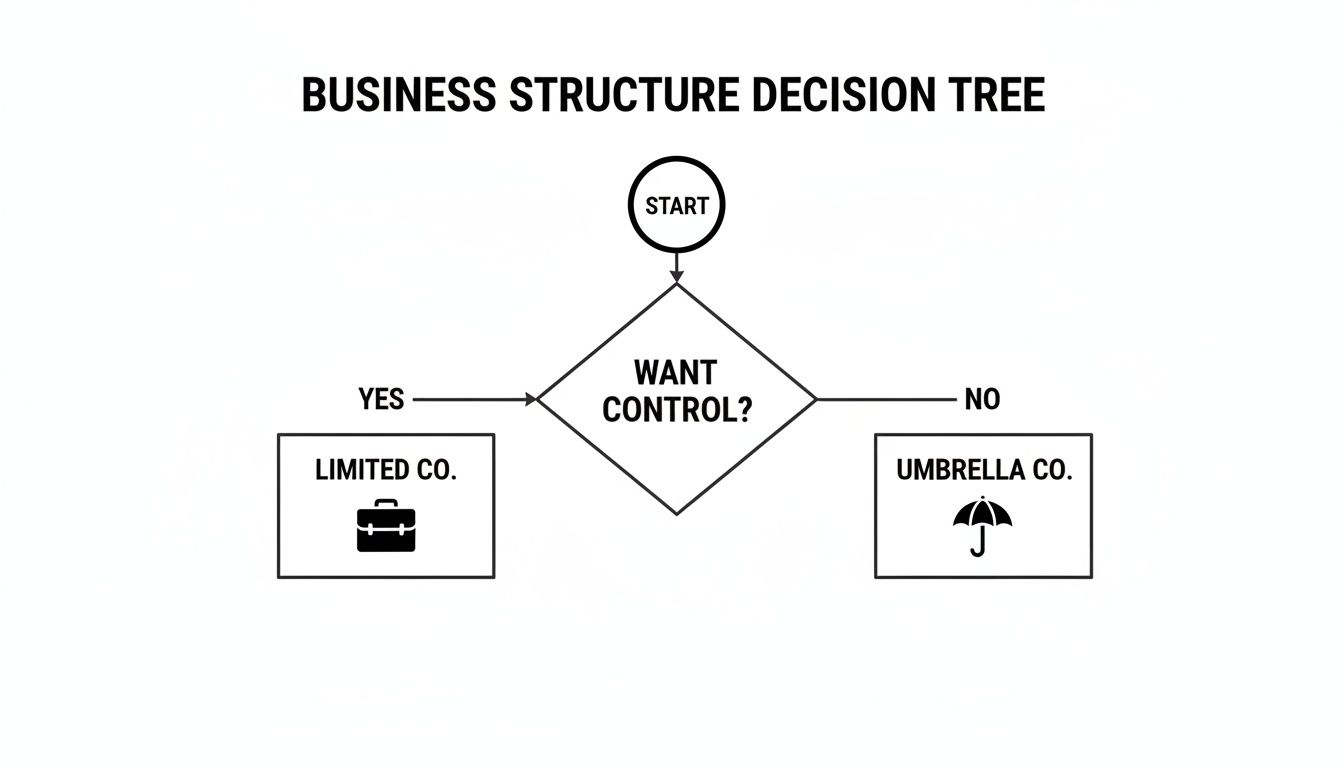
As you can see, if you are driven by the desire for control over your finances and business direction, a limited company is usually the way to go. If simplicity and minimal administration are more your style, an umbrella company is often a better fit.
How Much Does It Cost to Set Up a Limited Company?
You might be surprised at how affordable it is to get started. Registering directly with Companies House online will only set you back £12, and it is usually all completed within 24 hours.
That said, many contractors prefer to use a formation agent or their accountant to get everything right from day one. This service typically costs between £50 and £200 but can save you a lot of headaches down the line by ensuring all the paperwork is accurate.
Can I Run a Limited Company While Holding Down a Full-Time Job?
Absolutely. There is nothing in the rulebook stopping you from being a company director while also being employed somewhere else.
It is actually a very common setup for people starting out, taking on freelance projects alongside their permanent role. The only thing to keep an eye on is your overall tax position, as your income from all sources will be added together to work out what you owe.
What Are My Main Responsibilities as a Director?
Being a director comes with a few legal duties, but they are not as daunting as they sound. At its core, it is all about running the company in a responsible and compliant way.
Your key duties really boil down to this:
- Play by the rules: Stick to the guidelines set out in your company's articles of association.
- Keep good records: Maintain accurate company accounts and let Companies House know about any major changes.
- File your paperwork on time: This includes your annual accounts and a Confirmation Statement each year.
- Pay your taxes: Settle your Corporation Tax bill on any profits the company makes.
- Act in the company's best interests: This means putting the company's success ahead of your personal gain.
Honestly, one of the best moves any new director can make is to get a good accountant on board from the start. They will keep you on the straight and narrow, handling the compliance so you can focus on what you do best (your contract work) while still reaping all the benefits of your limited company.
Is a Limited Company Right for Me if My Contracts Are Inside IR35?
This is a big one. If your work is consistently deemed ‘inside IR35’, many of the tax advantages of operating as a limited company evaporate.
When a contract falls inside IR35, your client has to deduct tax and National Insurance just as if you were an employee on their payroll. In this situation, the administration that comes with running your own company can start to feel like more trouble than it is worth. For most contractors working inside IR35, an umbrella company is a far simpler and more straightforward solution.
Navigating the world of contracting can feel complex, but you do not have to do it alone. At UmbrellaCompany.com, we specialise in helping contractors find the perfect, compliant solution for their needs. Compare trusted, accredited providers in minutes.


