


Deciding to operate as a limited company can be a game-changer for UK contractors. It offers some serious perks, such as protecting your personal assets through limited liability, opening up greater tax efficiency, and giving your professional image a real boost.
This guide explains what those benefits mean in practice. We will explore how creating a separate legal entity shields your personal finances, improves your take-home pay, and unlocks bigger contract opportunities.
Why Contractors Choose the Limited Company Route
Picking the right business structure is one of the biggest decisions you will make as a contractor. In this guide, we will explore what operating as a ‘limited’ company means for you day-to-day. We will look at how it can shield your personal finances, genuinely improve your take-home pay, and open doors to bigger, more lucrative contracts.
We will compare it directly against being a sole trader or using an umbrella company, so you can see the practical trade-offs for your career. To kick things off, the table below gives a quick, at-a-glance summary of the key benefits we are about to discuss.
Limited Company Advantages at a Glance
This summary table gets straight to the point, comparing the key benefits of operating as a limited company versus a sole trader. It highlights the differences that matter most to UK contractors.
| Benefit | Limited Company | Sole Trader |
|---|---|---|
| Personal Liability | Protected. Your personal assets are separate from business debts. | Unlimited. Your home and savings are at risk if the business fails. |
| Tax Efficiency | High. Pay Corporation Tax on profits and take income via a mix of salary and dividends, often lowering your overall tax bill. | Lower. All profits are taxed as personal income at higher rates, including National Insurance. |
| Professional Image | Enhanced. The 'Ltd' status boosts credibility and is often required for larger clients and public sector contracts. | Basic. Seen as a smaller, less formal operation, which can limit access to high-value opportunities. |
| Funding & Growth | Easier. Can sell shares to raise capital and is often viewed more favourably by lenders. | Difficult. Raising capital is limited to personal funds or loans, with no option to issue shares. |
| Business Name | Protected. Your registered company name is unique and cannot be used by another limited company in the UK. | Unprotected. Another business can trade under a similar name, potentially causing confusion. |
Choosing the right path is a big step. While being a sole trader is appealing for its simplicity, the limited company route provides a much more robust framework for contractors who are serious about growth, financial security, and professional credibility.
Each option comes with its own set of responsibilities and rewards, which we will unpack in the next few sections. You can also learn more about how to choose the right type of business structure in our detailed guide.
Building a Financial Firewall with Limited Liability

Think of a solid wall between your business finances and your personal life. This is probably the single biggest reason contractors choose to set up a limited company. It is a legal concept called limited liability, and it offers invaluable peace of mind.
When you register a limited company, you create something brand new in the eyes of the law, a distinct legal entity. This means the business is legally separate from you, the owner. It can sign contracts, own equipment, and take on debt, all in its own name.
This separation is the bedrock of your financial protection. If the business ever ran into trouble, any claims from creditors or lawsuits are made against the company's assets, not yours. Your home, car, and personal savings are kept safely out of reach.
The Contrast with Sole Trader Status
For a sole trader, that firewall simply does not exist. The law sees no difference between the individual and the business. You are one and the same, which means you have unlimited personal liability.
If a sole trader's business racks up debts it cannot pay, creditors can legally come after your personal assets to get their money back. This is not just a minor detail; it is a fundamental difference in risk that every contractor needs to understand.
The trend is clear. According to UK government statistics, the number of limited companies shot up by 66% between 2010 and 2023, while sole proprietorships grew by just 17%. This tells a story of business owners opting for the security that incorporation provides. You can see the full business population estimates on GOV.UK for a deeper dive.
Limited Liability in a Real-World Scenario
Let’s put this into a practical example to see how it works.
- Meet Alex, an IT Contractor: Alex runs his business as 'Alex IT Solutions Ltd' and lands a big project developing new software for a client.
- The Project Hits a Snag: Through no fault of his own, unforeseen technical problems delay the project significantly, costing the client revenue.
- The Legal Claim: The client decides to sue for damages, claiming £50,000 in losses.
Because Alex operates as a limited company, the legal claim is against Alex IT Solutions Ltd. The company’s assets, such as its bank balance and equipment, are at risk. But Alex’s personal home, savings, and car are completely protected from the lawsuit.
If Alex were a sole trader, the situation would be drastically different. The client would be suing Alex personally, putting his family home and life savings on the line. This is the financial firewall in action, allowing contractors like Alex to take on ambitious projects with confidence, knowing their personal world is secure.
If you are currently working as a sole trader, making the switch is something to seriously consider. You might find our guide on changing from a sole trader to a limited company helpful.
Optimising Your Earnings Through Smart Tax Planning
For many contractors, one of the biggest draws of going limited is the potential to be significantly more tax-efficient. This is not about loopholes; it is about structuring how you pay yourself in a way that works with the UK tax system, not against it.
The most common strategy is to move away from taking a single, large salary. Instead, you pay yourself a combination of a small, sensible salary and take the remainder of your income as dividends from company profits.

Salary and Dividends: A Powerful Combination
This two-pronged approach works because salaries and dividends are treated very differently by HMRC. The idea is to set a small salary, just enough to qualify for National Insurance (NI) credits which protect your future State Pension entitlement, but low enough that you pay minimal or zero NI contributions.
Dividends, which are distributions of the company's profits after Corporation Tax has been paid, are the game-changer. Crucially, they are not subject to National Insurance. This is the key advantage over being a sole trader, where every penny of profit is liable for NI.
Your company will pay Corporation Tax on its profits. The current rate is 19% for profits up to £50,000, rising to 25% for profits over £250,000. These rates are often much more manageable than the higher-rate income tax bands sole traders can quickly fall into.
A Practical Example: Contractor Earnings of £80,000
Let’s see how this plays out in the real world. Imagine a contractor, Sarah, invoices £80,000 in one year through her limited company.
- Her Salary Strategy: Sarah pays herself a director's salary of £12,570. This matches the personal tax-free allowance, so she pays no Income Tax or National Insurance on it. This salary is also a legitimate, tax-deductible expense for her company.
- Calculating Corporation Tax: Her company's remaining profit is £67,430 (£80,000 – £12,570). The company pays Corporation Tax on this amount, which comes to roughly £13,857.
- Profit Available for Dividends: After tax, there’s £53,573 left in the company pot. Sarah can now pay this out to herself as a dividend.
- Personal Dividend Tax: The first £500 of dividends are tax-free. The rest is taxed at the basic rate of 8.75%, leaving her with a personal tax bill of around £4,644.
When all is said and done, Sarah’s total take-home pay is approximately £61,499. A sole trader earning the same £80,000 would typically take home around £56,500 after paying their Income Tax and National Insurance. That is a difference of nearly £5,000 in her pocket, every single year.
Beyond Salary and Dividends
The financial control a limited company offers does not stop with the salary/dividend split. You gain a few other powerful tools for managing your money.
- Retaining Profits: You are not forced to take all the money out of the company each year. You can leave profits in the business account to smooth out cash flow, save for a new piece of equipment, or even choose to draw it in a future tax year when it might be more tax-efficient for you personally.
- Claiming Expenses: A limited company can claim a wider range of allowable business expenses. This opens the door to claiming for things like company pension contributions, certain training, or even the cost of an annual staff party. Every pound claimed as a legitimate expense is a pound you do not pay Corporation Tax on.
This level of control over your earnings is a fundamental reason why so many experienced contractors make the leap to a limited company. To get into the finer details, take a look at our full guide on how to pay less tax as a limited company.
Winning Bigger Contracts and Enhancing Your Professional Image

Let's be honest: in the contracting world, perception matters. When you are up against stiff competition for high-value projects, your business structure sends an immediate signal to potential clients. Operating as a limited company projects an image of stability and professionalism that a sole trader setup often struggles to match.
Having ‘Ltd’ after your business name is not just window dressing; it is a badge of credibility. It tells clients you have gone through the formal process of registering with Companies House, committing to a higher standard of transparency and accountability. For many, that is a clear sign you are a serious, long-term business partner, not just a freelancer testing the waters.
Unlocking High-Value Contracting Opportunities
This professional polish has very real consequences for your bottom line. It can be the key that opens doors to contracts that would otherwise be completely out of reach.
Many large organisations, especially in the public sector, have rigid procurement policies. For them, it is a matter of risk management and compliance, they often make it a non-negotiable rule to only work with incorporated businesses. A sole trader, no matter how talented, can be automatically filtered out before they even get a chance to bid.
By setting up as a limited company, you put your business on a level playing field with much larger competitors. Suddenly, you can tender for those more lucrative, longer-term projects that are crucial for growth.
A Gateway to Business Funding and Investment
That credibility also works wonders when you need to secure finance. The formal, transparent structure of a limited company makes it a far more attractive proposition for banks, lenders, and investors.
Because a limited company is required to file annual accounts that are publicly available, it provides a level of financial clarity that sole traders simply do not have. This makes it much easier for potential backers to assess the health of your business, which naturally lowers their perceived risk.
This is not just about looking good on paper; it has a tangible impact on your ability to scale. Your 'Ltd' status makes you a more appealing candidate for loans and investment, and clients in sectors like IT and consulting often see it as a basic requirement for any serious bid. This trend is clear across the UK, with more insight available on why freelancers are choosing the limited company route.
The advantages really shine when you need to raise capital:
- Business Loans: Lenders are far more comfortable offering business loans to a limited company, thanks to its separate legal identity and clear financial records.
- Issuing Shares: Unlike a sole trader, you can sell shares in your company to investors, raising capital to fund expansion, buy new equipment, or develop a new service.
- Supplier Credit: The perceived stability of a limited company can also make it much easier to negotiate better credit terms with your suppliers.
Ultimately, choosing to become a limited company is an investment in your professional brand. It signals a serious commitment to your business, opening doors to bigger contracts, better funding, and a more secure path to long-term success.
The Trade-Offs: What is the True Cost of Running a Limited Company?
While the benefits of going limited are compelling, it is not a one-way street. Running your own company comes with a new set of responsibilities, and it is essential to go in with your eyes wide open.
This is not about putting you off. It is about making sure the limited company route truly fits your career goals and how you like to work. For most contractors, the trade-offs are a small price to pay for the financial control and professional standing they gain.
The Admin: More Paperwork on Your Plate
As a company director, you are legally responsible for keeping your company's affairs in order. This means filing the right documents, with the right people, at the right time. For many contractors, this is the single biggest worry about making the leap.
Here is a quick summary of your main duties:
- Annual Accounts: A yearly financial report card for your company that gets filed with Companies House.
- Company Tax Return (CT600): This is how you tell HMRC what your company earned and calculate your Corporation Tax bill.
- Confirmation Statement: A simple annual check-in with Companies House to confirm your company details (like directors and address) are still correct.
- VAT Returns: If you are VAT registered, you will need to file these with HMRC, usually every three months.
Now, that list might look intimidating. But here is the reality: almost no contractor does this all by themselves. A specialist accountant will handle all of it, leaving you free to focus on your actual work.
The Financial Costs
Setting up a limited company is surprisingly cheap, but there are ongoing running costs to factor into your budget.
The main one is your accountant. Their fees will cover all those filings we just mentioned, plus payroll, tax advice, and generally keeping you compliant. To see what that looks like in practice, you can check out our guide to typical limited company accountant fees.
Think of your accountant not as a cost, but as an investment. A good one will almost certainly save you more in tax than you pay them in fees, while also taking a huge amount of stress off your shoulders.
The IR35 Factor You Cannot Ignore
No conversation about contracting through a limited company is complete without talking about IR35. In short, this is the tax legislation that determines if you are a genuine business or a ‘disguised employee’ in the eyes of HMRC.
If a contract you are working on is deemed ‘inside IR35’, the tax efficiency of your limited company is switched off for that specific job. Your client has to deduct income tax and National Insurance from your invoice before it even hits your company bank account, just like a regular employee.
You are left with all the admin of running a company but without the main financial reward. This is why for any inside IR35 contracts, many contractors find it far simpler and more sensible to use a compliant umbrella company. It allows you to keep your limited company ready for any ‘outside IR35’ work that comes along, giving you the flexibility to handle both situations correctly.
Your Questions About Limited Companies Answered
Taking the leap to a limited company is a big step, and it is natural to have a few lingering questions. To help you get completely clear on whether it is the right move for you, we have put together straightforward answers to the questions we hear most often from contractors just like you.
At What Income Level Should a Contractor Consider a Limited Company?
There is not a magic number set in stone, but a good rule of thumb from most accountants is to start thinking seriously about a limited company once your annual profits are consistently hitting the £30,000 mark.
Why that figure? Below this, the extra admin and accountancy fees can sometimes cancel out the tax benefits. But once you are clearing £30,000, the tax efficiency of a salary-and-dividend structure really kicks in. The savings on National Insurance, in particular, often become significant enough to easily outweigh the running costs.
Can I Use My Limited Company for a Contract Inside IR35?
Technically, yes, you can. But it is crucial to understand that the financial upside almost completely disappears.
When a contract is deemed ‘inside IR35’, your client or agency is required to deduct tax and National Insurance from your invoice before it even reaches your company bank account, just like an employee. This cancels out the primary tax-saving benefit of using your company for that specific contract.
For this reason, most contractors find it is far simpler to use an accredited umbrella company for their inside-IR35 roles. This keeps things clean and compliant, leaving their limited company free for any future outside-IR35 work.
The flowchart below gives a quick overview of the IR35 decision process.
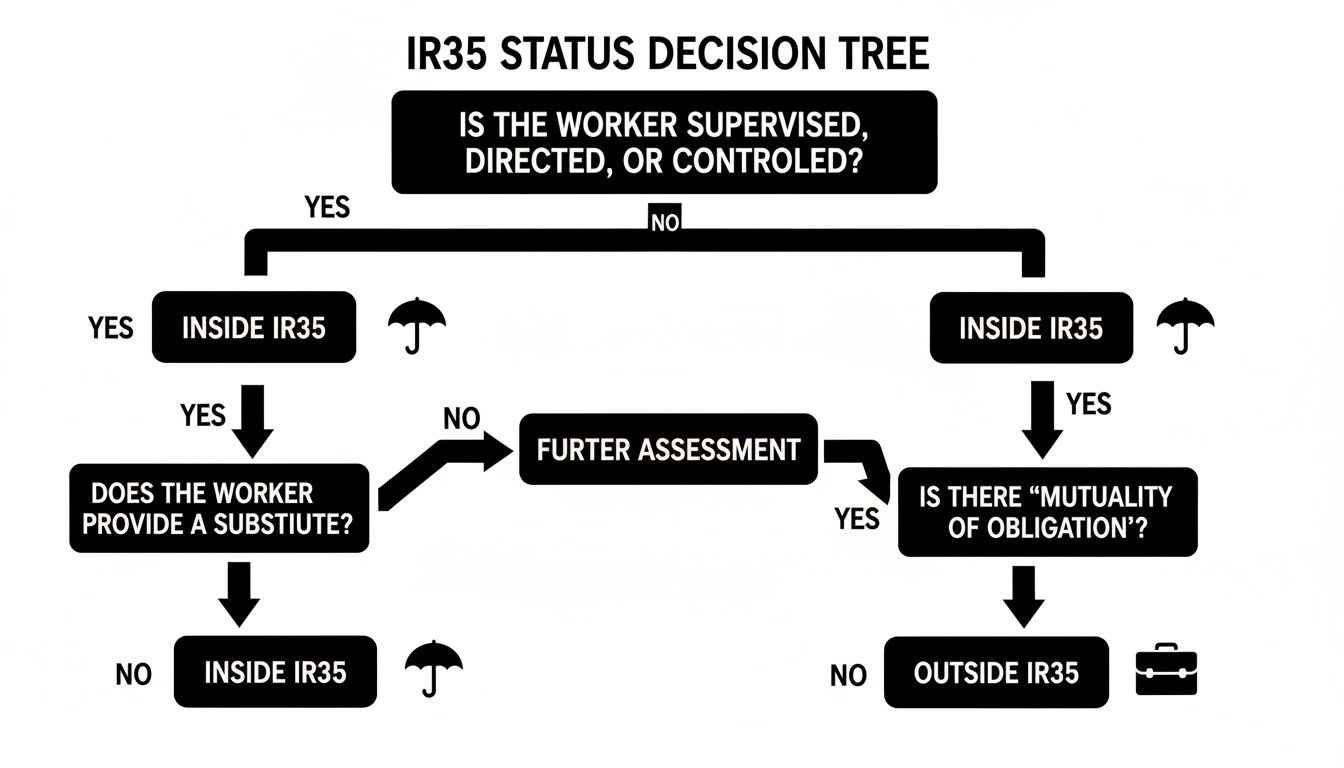
As you can see, if you land 'Inside IR35', an umbrella company is the most practical route. If you are 'Outside IR35', your limited company becomes the vehicle of choice.
What Are the Main Administrative Duties of a Company Director?
Stepping up as a company director means you have a few legal responsibilities to keep everything above board. Do not worry, it is more straightforward than it sounds.
The main jobs on your to-do list are:
- Filing your annual accounts and a Confirmation Statement with Companies House.
- Submitting a Company Tax Return (CT600) to HMRC each year.
- Running a company payroll if you are paying yourself a salary.
- Keeping organised and accurate financial records of everything coming in and going out.
That might look like a lot, but here is the good news: the vast majority of contractors hand this over to a specialist accountant. A good contractor accountant will take care of all these filings for you, making sure you are always compliant and letting you focus on your actual work.
Ultimately, the choice between a limited company and an umbrella solution comes down to your contracts and where you want to take your career. Here at UmbrellaCompany.com, we give you the expert guidance and tools to compare compliant providers, helping you find the perfect fit for your situation in minutes.


