


Welcome to the practical, no-nonsense guide to sorting out your finances as a UK consultant. We are going to cut through the jargon and get straight to what you need to know, from day-to-day bookkeeping to keeping HMRC happy. Think of this as your financial roadmap. Get it right from the start, and you can focus on what you do best.
Getting Your Finances in Order as a UK Consultant
Stepping into the world of consultancy is an exciting move, full of freedom and opportunity. The UK consulting scene is booming; revenue shot up from £10.56 billion in 2018 to a staggering £20.4 billion in 2023. That is a massive market, but to build a lasting business, you absolutely must get a handle on the numbers.
With this independence comes a whole new set of financial responsibilities. This is not just about ticking boxes for HMRC; it is about making your money work for you, maximising what you keep, and building a secure future. A little bit of organisation now will save you a world of pain later.
What You are Responsible For
When you are a self-employed consultant, you are not just the expert, you are the Chief Financial Officer. Your financial duties go way beyond just firing off invoices. You need to be on top of your money to keep the business healthy and profitable, from tracking every pound coming in to putting money aside for tax well ahead of time. A good place to start is with our guide on the best invoicing software for contractors.
Here is a quick rundown of your main responsibilities:
- Choosing Your Business Structure: This is your first big decision. Will you be a sole trader, set up a limited company, or work through an umbrella company? Each route has very different implications for your tax bill and the amount of admin you will have to do.
- Tax and National Insurance: You are now in charge of calculating and paying your own Income Tax and National Insurance Contributions (NICs). These are not taken off your pay automatically like in a permanent job, unless you decide to use an umbrella company.
- Keeping Good Records: HMRC legally requires you to keep clear, organised records of all your business income and expenses. This is not just a chore; it is essential for filing your tax return correctly and making sure you claim every expense you are entitled to.
- Invoicing and Getting Paid: You need to create professional invoices, send them out on time, and keep track of who has paid you. This is the lifeblood of your business, and staying on top of it is critical for managing your cash flow.
To give you a clearer picture, here is a quick summary of those core duties.
Key Accounting Responsibilities for UK Consultants
| Responsibility | Why It Matters |
|---|---|
| Business Structure | Directly impacts your tax liability, personal liability, and administrative workload. |
| Tax & NICs | You are personally responsible for ensuring the correct amounts are paid to HMRC on time. |
| Record Keeping | A legal requirement and essential for accurate tax returns and claiming allowable expenses. |
| Invoicing & Cash Flow | Ensures you get paid promptly and can manage your business's financial health. |
Getting these basics right is the foundation of a successful consulting business.
By building solid financial habits from day one, you free yourself up to focus on what really matters: delivering fantastic work for your clients, with the peace of mind that your accounts are in perfect order.
Choosing Your Path: Umbrella vs. Limited Company
Right at the start of your consulting journey, you will face a crucial decision: how to structure your business. This is not just a box-ticking exercise; it fundamentally shapes everything from your tax bill and admin workload to your final take-home pay. Getting this right lays a solid foundation for your entire career.
The choice really comes down to a trade-off. Are you looking for simplicity and minimal fuss, or are you after greater control and tax efficiency? Each route has its place, depending on where you are in your career, your goals, and frankly, how much paperwork you are willing to handle.
The Simplicity of an Umbrella Company
Think of an umbrella company as the 'plug-and-play' option. It is a brilliant way to get started without the headache of running a full-blown company.
Essentially, the umbrella company becomes your employer. They handle all the tricky bits, like calculating and deducting your PAYE (Pay As You Earn) tax and National Insurance contributions straight from your earnings. You just focus on delivering for your client.
This setup is perfect for newcomers to contracting or those on shorter gigs. It completely strips away the admin burden. You submit your timesheets, and they sort out the rest, making sure you get paid on time and stay on the right side of HMRC.
Here is why it is so popular:
- Minimal Administration: Forget about annual accounts or Corporation Tax returns. The umbrella company manages all invoicing and tax calculations for you.
- Employment Rights: A big plus is that you get access to statutory rights like holiday pay, sick pay, and a workplace pension.
- Compliance Certainty: A reputable, FCSA or Professional Passport accredited umbrella takes the worry out of tax compliance, which is a massive relief for any contract that falls ‘inside IR35’.
The Control of a Limited Company
The alternative is to set up your own limited company. This means you are the director of a separate legal entity, putting you firmly in the driver's seat. It offers far more financial control and the potential for a higher take-home pay by blending a small salary with dividends.
This is the path often taken by career contractors with higher earnings who do not mind getting more hands-on. As a director, you have legal duties, like filing annual accounts with Companies House and a Corporation Tax return with HMRC. It is more work, no doubt, but the financial rewards can be well worth it.
The main draws of going limited are:
- Tax Efficiency: You can structure your income with a tax-efficient mix of a low salary and dividends, which are taxed at a lower rate.
- Professional Image: Operating as a limited company often projects a more established, professional image to clients.
- Greater Control: You have total control over the company's finances and can make strategic decisions about how to invest and what expenses to claim.
This simple decision tree can help visualise the choice, especially if you are new to the game.
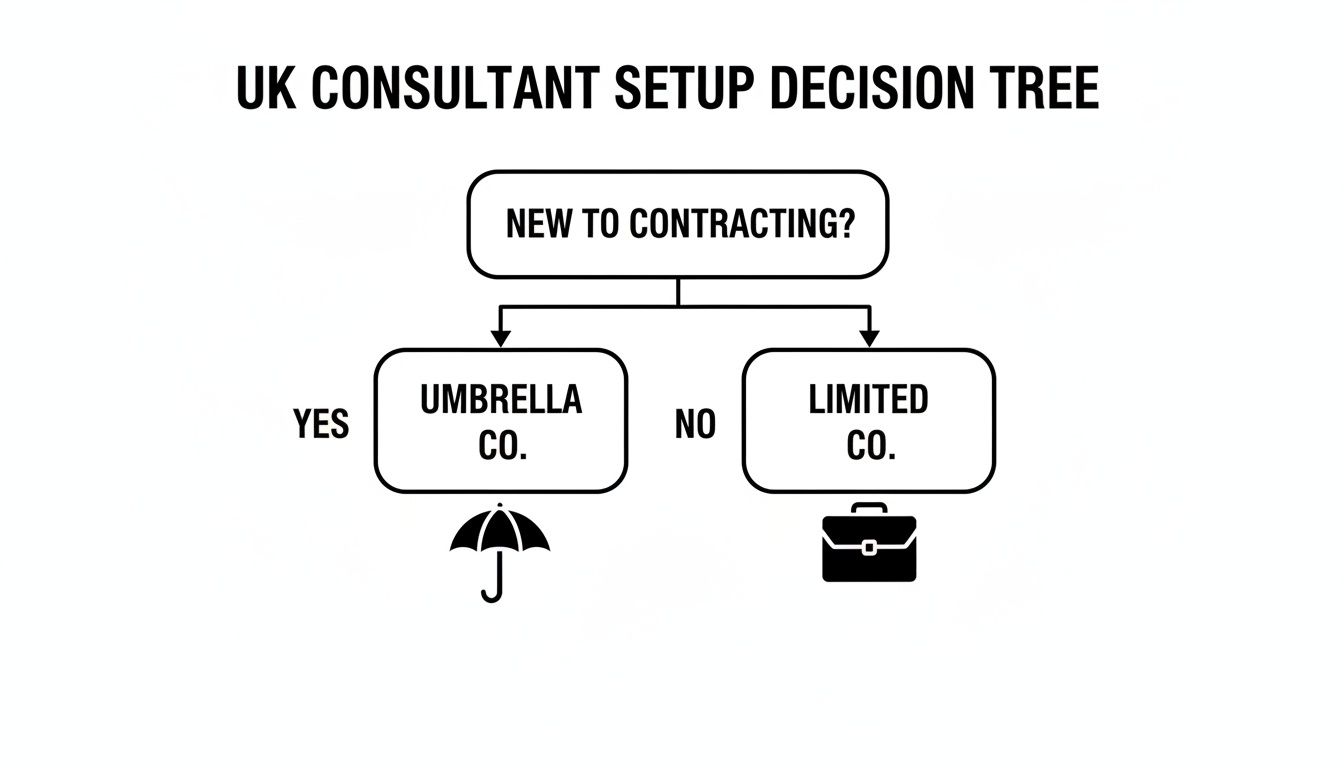
As you can see, the umbrella route is often the most straightforward starting point. The limited company path, on the other hand, is for those who are ready to take on the management side of things.
Making the Right Choice for You
Ultimately, your personal situation should guide this decision. Are you just dipping your toe in the water or working on a short contract that might be inside IR35? An umbrella company is a simple, low-risk solution.
If, however, you are an experienced consultant building a long-term career with a string of clients and contracts that are clearly outside IR35, the tax planning potential of a limited company becomes very attractive. It demands more from you, but the financial upside can be significant. For a much deeper comparison, have a look at our detailed guide on umbrella company vs a limited company.
Your business structure is not just an administrative choice; it is a strategic one. It directly influences your financial health, your legal obligations, and the amount of time you spend on non-billable tasks.
Proper accounting for consultants starts here. Think carefully about your likely income, the IR35 status of your work, and how much admin you are prepared to take on. Weighing these factors honestly will help you pick the structure that truly supports your professional and financial goals from day one.
Managing Your Tax and National Insurance Obligations
Getting your head around your duties to HMRC is one of the first, and most important, steps for a stress-free consulting career. This bit is all about your main tax obligations and how they change depending on your business structure. Nailing this is a cornerstone of good accounting for consultants.
How you will handle your tax comes down to one big choice: umbrella or limited company? Go down the umbrella route, and the whole process is pretty much automated. Run your own limited company, and you have got more to do, but you also get far more control over your financial planning.
Tax for Umbrella Company Consultants
When you join an umbrella company, you are essentially their employee. That means they take care of your tax and National Insurance Contributions (NICs) for you through the Pay As You Earn (PAYE) system, just like any permanent employee. It is wonderfully straightforward.
Your umbrella company simply deducts everything from your earnings before the money hits your bank account:
- Income Tax: Calculated based on your tax code and sent straight to HMRC on your behalf.
- Employee’s National Insurance: This is your contribution towards things like the State Pension. It is deducted automatically.
- Employer’s National Insurance: As your technical employer, the umbrella company has to pay this too. This cost is factored into the assignment rate you agree with the client.
This setup completely removes the headache of doing your own tax calculations. You get a clear payslip detailing all the deductions, so you do not have to worry about stashing cash away for a massive tax bill later on. To get a better feel for how this works in practice, have a look at our detailed explanation of the Pay As You Earn system.
Tax for Limited Company Directors
As the director of your own limited company, you have got a few more hats to wear when it comes to tax. The company is its own legal entity, separate from you, which means both the business and you as an individual have taxes to pay.
Here are the main ones you will need to manage:
- Corporation Tax: This is a tax on your company’s profits. Once you have paid your salary and other allowable business expenses, your company pays Corporation Tax on whatever profit is left.
- Personal Tax (Income Tax & NICs): You will pay Income Tax and National Insurance on the salary you draw from your company. You will also pay Dividend Tax on any dividends you take out of the company’s post-tax profits.
- Employer's National Insurance: Your company also has to pay employer’s NICs on the salary it pays you.
A very common strategy for tax efficiency is to pay yourself a small salary, often just enough to stay below the National Insurance threshold, and take the rest of your income as dividends. Dividends do not attract National Insurance and are taxed at a lower rate than salary, which can make a big difference.
Understanding Value Added Tax (VAT)
Beyond taxes on your income, you might also need to get to grips with Value Added Tax (VAT). This is the tax charged on most goods and services sold in the UK.
You are legally required to register for VAT if your company’s taxable turnover goes over the current threshold, which is £90,000 in a 12-month period (as of April 2024). You can also choose to register voluntarily even if you are below this figure. The main benefit of doing so is that you can reclaim the VAT on your business purchases.
For many consultants, the VAT Flat Rate Scheme is a real lifesaver. Instead of painstakingly tracking the VAT on every single purchase, you just pay HMRC a fixed percentage of your turnover. It can seriously cut down on your admin, but you will need to check if your business type is eligible and if it actually makes financial sense for you. Staying organised here is also vital for complying with Making Tax Digital (MTD) rules, which now require you to keep all your VAT records digitally.
Claiming Allowable Business Expenses Correctly

Getting to grips with what you can claim as a business expense is one of the cornerstones of good accounting for consultants. When you do it right, you lower your taxable profit, which means you pay less tax and keep more of your hard-earned money. Simple as that.
But the rules are not a one-size-fits-all deal. How you are set up, whether as a limited company director or working through an umbrella, completely changes what you can claim and how you do it. Nailing this is non-negotiable for staying compliant and making your finances work for you.
The Golden Rule: Wholly and Exclusively
HMRC has one central principle that governs all business expenses. It is often called the 'golden rule'. For any cost to be allowable for tax relief, it must be incurred “wholly and exclusively” for the purpose of your trade.
What does that really mean? It means the expense cannot have a dual purpose where business and personal use get mixed up.
Think of it like this: a laptop you buy and use only for client projects is a straightforward business expense. But what about that sharp suit you bought for a big client presentation? If you also wear it to your cousin's wedding, it fails the test. Because of that personal benefit, it is no longer wholly for business.
HMRC’s “wholly and exclusively” rule is the bedrock of expense claims. Always ask yourself: "Was this cost incurred solely for my business activities?" If the answer is yes, you can usually claim it.
This rule is the foundation for every claim you make. However, how it is applied is very different for limited and umbrella company contractors, particularly since the IR35 reforms came into play.
Expenses for Limited Company Directors
As the director of your own limited company, you have the most freedom when it comes to claiming expenses. You are running a distinct business entity, which means a much broader range of costs can be put through the company books, as long as they all pass that "wholly and exclusively" test.
These costs are deducted from your company's income before Corporation Tax is worked out, which directly lowers your final tax bill.
Some of the most common allowable expenses for consultants with a limited company include:
- Office Costs: This could be rent for a dedicated office space or a claim for using your home as an office.
- Travel and Subsistence: You can claim for travel to meet clients, covering mileage, train tickets, and hotel stays, plus the cost of food and drink on overnight business trips.
- Equipment: The cost of essential kit like laptops, specialist software, and a business mobile phone are all fair game.
- Professional Fees: This covers things like your professional indemnity insurance, fees for your accountant, and subscriptions to relevant professional bodies (like the Chartered Management Institute).
- Training: Any courses or training that genuinely help you improve the skills needed for your consulting work are also allowable.
Expenses for Umbrella Company Employees
For contractors working through an umbrella company, the situation is far more restricted. Since the off-payroll working (IR35) reforms, most umbrella employees can no longer claim tax relief on travel and subsistence for their daily journey to a client’s office.
Why? Because HMRC now treats each assignment as a permanent workplace. That means your travel there is considered a regular commute, just like it would be for a permanent employee. The umbrella company, as your official employer, can generally only process expenses that are either paid back by the end client or are for travel to a temporary workplace (which is very unusual).
So, what can you claim? The list is pretty short:
- Business mileage for journeys you have to make between different client sites (but not your journey from home).
- Costs for professional subscriptions, but only if they are on HMRC’s approved list.
- Some specialist equipment you need for the job, but only if the client does not provide it.
It is absolutely vital you check the specific expenses policy of your umbrella company. Reputable providers, like those you will find recommended on UmbrellaCompany.com, are always crystal clear about what is and is not allowed, helping you steer clear of any trouble with HMRC.
Keeping Your Financial Records in Order

Think of good record-keeping as the control panel for your consulting business. It is not just about keeping HMRC happy; it is about having a clear, live view of your financial health. Without it, you are flying blind. You cannot accurately figure out your tax bill, claim all your expenses, or make smart decisions about where to take your business next.
Good records tell you exactly where your money is coming from, where it is going, and how much you need to tuck away for the taxman. Letting this slide is a recipe for disaster.
What Records You Must Keep
HMRC has very clear rules on this. If you run a limited company, you must keep all your records for six years from the end of the financial year they relate to. It sounds like a long time, but with a good system, it is straightforward.
Your non-negotiable list of records should include:
- All sales and income: This means a copy of every single invoice you send out.
- All business expenses: Hang on to every receipt and invoice for anything you buy for the business.
- VAT records: If you are VAT registered, you are required to keep detailed digital records under the Making Tax Digital rules.
- PAYE records: Essential if you employ anyone, and that includes paying yourself as a director.
- Personal income records: Things like dividend vouchers are a must if you are a limited company director.
- Business bank statements: These are the bedrock for reconciling your accounts and proving your numbers.
The easiest way to manage all this is digitally. A simple folder system on your laptop or in the cloud is a decent start, but modern software really takes the pain out of it.
Maintaining accurate financial records is not just a legal chore; it is a strategic tool. It gives you the hard data you need to understand your profitability, manage your cash flow, and plan for the future with real confidence.
The Power of Accounting Software
Honestly, manual spreadsheets are a thing of the past. Today's cloud accounting software, think platforms like Xero, FreeAgent, or QuickBooks, is an absolute game-changer for consultants. They automate so many of the tedious jobs that used to eat up hours, slashing the risk of human error and giving you your time back.
These tools link directly to your business bank account, pulling in transactions automatically. This makes reconciling, the process of matching your books to your bank statements, incredibly simple. You can see your income, expenses, and profit at a glance on a clean, easy-to-read dashboard.
There are a staggering 258,400 management consultants in the UK as of Q2 2025, contributing to a sector where exports alone are worth £5.9 billion. To stand out, or even just to manage your finances effectively, precise financial reporting is vital. Accurate records let you analyse your revenue streams and truly understand your profitability, supporting your growth at home and abroad. You can find more insights on the UK consulting market on Statista.com.
A Simple Record-Keeping Workflow
Let us walk through what this looks like day-to-day. Using accounting software makes the whole process feel less like accounting and more like just running your business.
- Issue an Invoice: You finish a project and generate a professional invoice right inside your software. A couple of clicks and it is sent to your client's inbox.
- Record an Expense: You are travelling to a client meeting and buy a train ticket. You snap a photo of the receipt with your software's mobile app, which then reads, digitises, and categorises the expense for you.
- Client Pays: The payment from your client lands in your business bank account.
- Reconcile Transactions: Your software automatically sees the client's payment and the train ticket expense in your bank feed. You just need to click to confirm and match them to the invoice and receipt you have already logged.
This simple, repeatable loop means your books are always current. It turns what could be a massive headache into a quick weekly task, giving you a constantly accurate picture of where you stand financially.
Navigating IR35 and Its Financial Impact
You simply cannot be a contractor in the UK without getting to grips with the off-payroll working rules, better known as IR35. This is not just another piece of tax jargon to skim over; it is a crucial bit of legislation that directly shapes how you are paid and how much tax you owe.
In a nutshell, IR35 is HMRC's way of figuring out if you are a genuine, independent business or a 'disguised employee' who should be paying tax like one. If your contract is deemed 'inside IR35', the taxman sees you as an employee for that specific engagement, completely changing the financial picture.
An 'inside IR35' status means your earnings are hit with the same PAYE tax and National Insurance Contributions (NICs) as a regular employee. This can seriously dent your take-home pay compared to operating outside the rules, making it a pivotal factor in accounting for consultants.
Understanding Your IR35 Status
Since the rule changes in April 2021, the ball is no longer in your court for determining your IR35 status on most contracts. The responsibility now falls to your end client. They are legally required to assess the working relationship and give you a formal Status Determination Statement (SDS).
So, what are they looking at? Their decision hinges on the real-world facts of how you work. While the details can get complex, the assessment boils down to a few core principles.
Key tests for your IR35 status include:
- Control: How much direct say does your client have over how, when, and where you do your work? If you are largely left to your own devices to deliver the agreed result, you look much more like an independent business.
- Substitution: Do you have a genuine right to send a qualified replacement to do the work instead of you? A real right of substitution is a powerful indicator that you are operating outside IR35.
- Mutuality of Obligation (MOO): Once the project is done, is the client obliged to offer you more work? And are you obliged to take it? A lack of this ongoing obligation is a hallmark of a contractor-client relationship, not an employer-employee one.
Getting your head around these concepts is non-negotiable. For a much deeper dive, you can learn more about how IR35 impacts contractors in our detailed guide.
The Financial Impact of an 'Inside IR35' Role
If your contract is determined to be inside IR35, your options for getting paid shrink dramatically. The most common and compliant path is to work through an umbrella company. The umbrella effectively becomes your employer, processing your fees through their PAYE system and sorting all the tax and NICs for you.
This route takes the compliance headache away, but it also means you lose the tax efficiencies of running your own limited company. You cannot pay yourself in a mix of salary and dividends; your entire income is treated as salary and taxed accordingly.
Operating 'Outside IR35'
On the flip side, when a contract is assessed as 'outside IR35', you can confidently operate through your limited company. This opens the door to the tax-efficient structure many contractors favour: taking a small, director's salary and drawing the rest of your profits as dividends.
However, a word of warning. It is not enough for the contract to say you are outside IR35. Your day-to-day working practices must back it up. You need to act and operate like an independent business at all times to protect yourself if HMRC ever decides to investigate.
To make things clearer, let us compare the two scenarios side-by-side.
IR35 Status and Its Accounting Implications
| Factor | Inside IR35 (Typically Umbrella) | Outside IR35 (Typically Limited Company) |
|---|---|---|
| Payment Method | Paid via PAYE salary after all tax deductions. | Paid gross to the limited company; director takes salary & dividends. |
| Tax Efficiency | Lower. Taxed as an employee, no access to dividends. | Higher. Can use a tax-efficient salary/dividend structure. |
| Admin Burden | Minimal. The umbrella company handles all tax and payroll. | Higher. Director is responsible for all company accounts and taxes. |
| Expense Claims | Highly restricted, mainly limited to business mileage between sites. | Broader range of allowable business expenses can be claimed. |
Ultimately, your IR35 status is probably the single biggest factor shaping your payment structure and what you actually take home. It is vital to understand the determination for every contract you take on and structure your affairs in a way that keeps you compliant.
A Few Common Questions on Consultant Accounting
Getting to grips with contractor finances always throws up a few questions. To help you feel more confident about your own approach to accounting for consultants, we have pulled together some of the most common queries we see and laid out some clear, straightforward answers.
Do I Still Need an Accountant if I Use an Umbrella Company?
Generally, no. One of the biggest draws of a compliant umbrella company is its simplicity. The umbrella firm effectively becomes your employer, which means they are responsible for handling all the PAYE tax and National Insurance calculations on your behalf.
They will process your timesheets, invoice the client, and pay you a salary once all the correct deductions have been sorted. This hassle-free process means you will not need to file a Self Assessment tax return for your contracting income, saving you the cost and complication of hiring an accountant for your business affairs.
What is the Best Way to Track My Business Expenses?
For limited company directors, dedicated accounting software or an expense-tracking app is by far the smartest way to go. These tools let you snap photos of receipts on the fly, categorise spending as it happens, and pull up reports in an instant. It is a world away from the old shoebox full of crumpled paper.
Moving to digital tools for expense tracking is a game-changer for getting your annual accounts right. For umbrella employees, while the scope for expense claims is much narrower, keeping a clean digital record of allowable costs like business mileage is still very good practice.
How Often Should I Be Doing My Bookkeeping?
Consistency is your best friend when it comes to stress-free bookkeeping. We always recommend setting aside a small chunk of time each week to keep your records up to date. This simple habit stops the job from snowballing into a monster task at the end of the month or, even worse, at your financial year-end.
A quick weekly check-in might involve:
- Sending out any new invoices for work you have just finished.
- Logging and categorising any new expenses from the past week.
- Reconciling your business bank account to make sure everything matches up.
Staying on top of your books gives you a sharp, real-time picture of your business's financial health, which is absolutely vital for making smart decisions and planning ahead.
Managing your finances as a consultant does not have to be a headache. Whether you are leaning towards the straightforward nature of an umbrella company or the greater control of a limited company, making an informed choice is the first step. UmbrellaCompany.com offers a simple way to compare trusted, compliant providers, helping you find the perfect fit for your contracting career. Find your ideal umbrella company in minutes at https://umbrellacompany.com.


