


Deciding how to structure your finances is one of the biggest calls you'll make as a UK IT contractor. It comes down to three paths: setting up your own limited company and hiring a specialist accountant for IT contractors, going with a straightforward umbrella company, or rolling up your sleeves and managing your limited company accounts yourself. Each route will have a major say on your tax bill, how much admin you're saddled with, and your legal responsibilities.
This guide will explain these options clearly, helping you understand the pros and cons of each so you can make a confident choice for your career.
Choosing Your Financial Path as an IT Contractor
As an IT contractor in the UK, getting your financial setup right is just as crucial as the code you write or the systems you manage. The way you operate directly shapes your take-home pay, your exposure to IR35, and how much of your precious time is eaten up by paperwork. A smart choice at the start sets you up for a sustainable and profitable career.
We find there are really only three main options:
- Limited Company with an Accountant: This gives you the most control and the highest potential for tax planning. It’s the go-to for career contractors who are confident they’ll be operating outside IR35.
- Umbrella Company: A simple, compliant option that takes IR35 worries and admin off your plate. It's ideal for shorter contracts or if you're just dipping your toes into the contracting world.
- DIY Limited Company: Puts you in the driver's seat completely, but you'll need serious financial savvy and time to handle all the statutory filings and tax returns yourself.
The good news is that the UK's accounting industry is massive and more than capable of supporting contractors. The sector is forecast to hit a revenue of £39.8 billion in 2025, which means there's a deep pool of experts who live and breathe complex contractor legislation. If you want to dive deeper, our detailed guide on accounting for contractors is a great place to start.
Choosing the right structure isn't just about tax. It's about aligning your business administration with your career goals, risk appetite, and the time you're willing to commit to financial management.
Here’s a quick look at how the options stack up.
| Feature | Limited Company & Accountant | Umbrella Company | DIY Limited Company |
|---|---|---|---|
| Control | Full control over business finances. | Limited control; you are an employee. | Complete control and responsibility. |
| Admin | Managed by your accountant. | Minimal; handled by the provider. | High; you handle all filings. |
| IR35 Risk | You and your accountant manage it. | No direct risk; you are an employee. | Full responsibility falls on you. |
| Tax Planning | High potential for efficiency. | PAYE structure; limited options. | Dependent on your expertise. |
Comparing Your Core Options: Accountant vs Umbrella vs DIY
Picking the right financial setup is a pivotal moment for any IT contractor. It’s a decision that directly shapes your tax bill, your admin workload, and the professional support you have in your corner. Getting to grips with the real-world, day-to-day differences between hiring an accountant, using an umbrella company, or going it alone is the first step to making a smart choice.
This flowchart maps out the main paths you can take, helping you see which route aligns with your priorities, whether that's control, simplicity, or expert support.
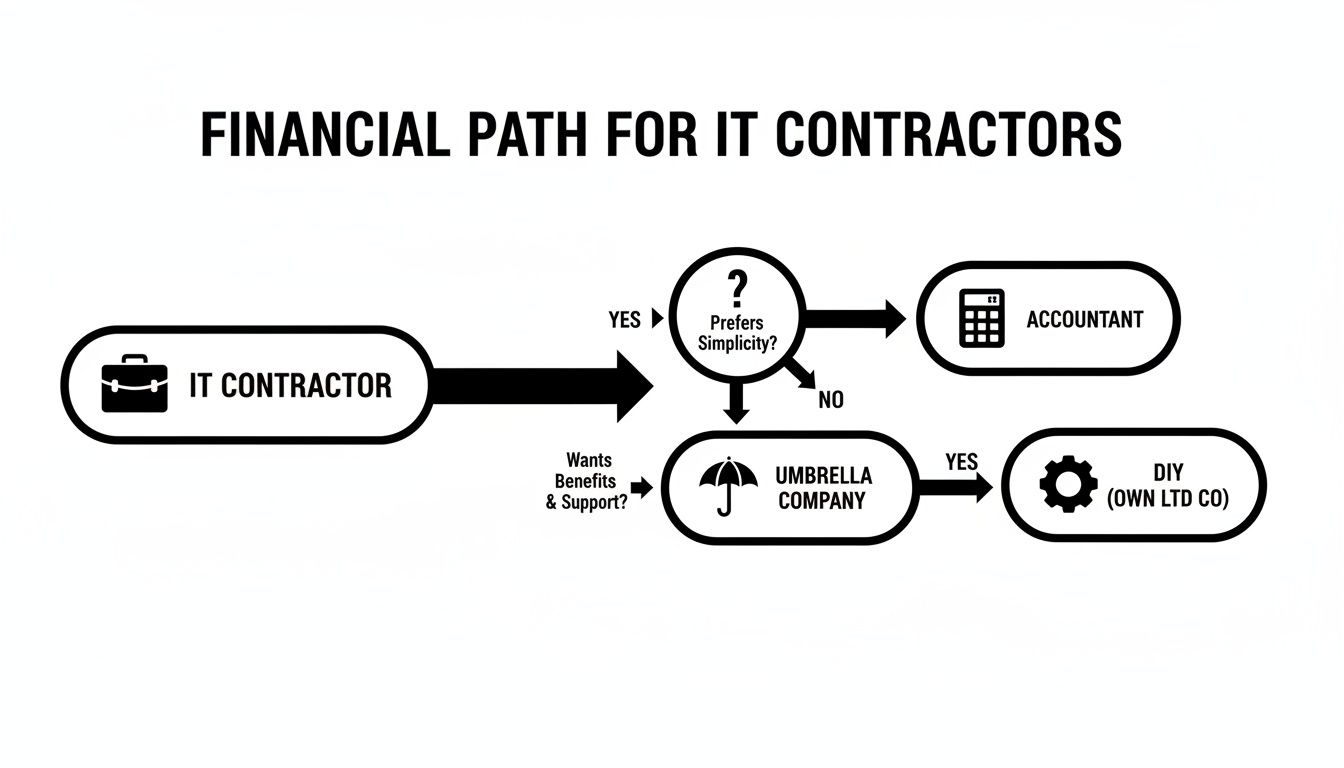
As you can see, what you value most, be it maximum take-home pay, zero paperwork, or total autonomy, points you toward a specific setup. Let’s unpack these choices in more detail.
Limited Company With a Specialist Accountant
For most career contractors, teaming up with specialist accountants for IT contractors is the default route. This path puts you in the director’s chair of your own limited company, giving you full control over your finances.
Think of your accountant as your financial co-pilot. They take care of the heavy lifting (annual accounts, Corporation Tax returns, VAT filings) but more importantly, they offer strategic advice on IR35 and tax planning to keep you compliant and efficient. This setup offers the greatest potential for maximising your earnings through a mix of salary and dividends. You can learn more about this in our guide to the most tax-efficient contractor setup in the UK.
This model is a perfect fit for IT contractors on high day rates with long-term projects that are confidently outside IR35. It does ask for a bit of discipline with your record-keeping, but the payoff in financial control is huge.
Umbrella Company Employment
If simplicity and a quiet life are what you’re after, an umbrella company is a brilliant solution. When you sign up, you effectively become their employee for the length of your contract. They manage all the payroll admin, deducting tax and National Insurance through PAYE, just like any permanent job.
This route sidesteps IR35 worries entirely because you’re already being taxed at source. The admin is next to nothing: you submit your timesheets, and the umbrella company handles the invoicing and pays you a salary. Done.
An umbrella company is a compliant, hassle-free way to start contracting. It’s particularly well-suited for short-term gigs, public sector roles, or any contract that’s been deemed inside IR35.
You give up some financial control compared to running a limited company, but what you gain is unparalleled simplicity. It frees you up to focus purely on your IT work, without the headache of running a business.
The DIY Limited Company Approach
Going it alone means setting up and running your own limited company without an accountant’s help. This route gives you absolute control but also saddles you with the full weight of financial and legal compliance.
You're responsible for everything. Company formation, bookkeeping, filing accounts with Companies House, and submitting tax returns to HMRC all fall on your shoulders. Modern accounting software helps, but there's no substitute for a deep understanding of UK tax law, VAT, and IR35. One wrong move can be expensive.
Frankly, this path is only for contractors with a strong financial background and the time to sink into serious admin. The money you might save on accountancy fees can vanish in an instant with a single fine for an incorrect filing.
IT Contractor Financial Options: A Direct Comparison
To help you weigh up the trade-offs, the table below breaks down the key differences between each option at a glance.
| Decision Factor | Limited Company with Accountant | Umbrella Company | DIY Limited Company |
|---|---|---|---|
| Financial Control | Maximum control over business funds, salary, and dividend declarations. | Minimal control as you are an employee paid via PAYE. | Absolute control, but also total responsibility for all financial decisions. |
| Tax Efficiency | Highest potential through salary and dividend planning, and claiming a wide range of business expenses. | Limited to PAYE; some legitimate business expenses may be claimable. | Dependent on your expertise; high potential but also high risk of error. |
| Admin Workload | Low to moderate; you manage invoicing and expenses, your accountant handles the rest. | Very low; your main task is submitting timesheets. | Very high; you are responsible for all statutory filings and bookkeeping. |
| IR35 Risk | Managed by you and your accountant; requires due diligence for each contract. | No direct risk; you are an employee for tax purposes, making IR35 a non-issue. | Full responsibility; you must assess your IR35 status and defend it if challenged. |
| Cost | Monthly accountant fees, typically £100-£150. | A weekly or monthly margin, usually £20-£30 per week. | Software costs, plus your own time, which has a significant value. |
| Support | Expert, proactive advice from a specialist who understands the IT sector. | Compliance support and HR functions from the umbrella provider. | None; you must rely on your own research or pay for ad-hoc advice. |
Ultimately, the best path forward comes down to your personal situation, your appetite for risk, and where you see your contracting career heading.
How IR35 and Tax Obligations Shape Your Choice

For IT contractors in the UK, navigating IR35 is one of the biggest headaches. This complex tax legislation is designed to spot ‘disguised employees’, and your choice of business structure is your first and most critical line of defence. How you decide to operate directly impacts your risk, your tax bill, and the amount of admin on your plate.
Whether you go for a limited company, an umbrella company, or even try to manage it all yourself, each path has a completely different relationship with HMRC and the IR35 rules. Getting this choice right is fundamental to your compliance and, frankly, your peace of mind.
Limited Company: You’re in the Driving Seat for IR35
Running your own limited company gives you the most potential for tax efficiency, but it also means the responsibility for IR35 compliance lands squarely on your shoulders. As the company director, you are legally required to assess your IR35 status for every single contract you take on.
This is where a specialist accountant for IT contractors becomes indispensable. They’re not just number-crunchers; they’re your expert advisor, helping you scrutinise contract terms and your day-to-day working practices to build a solid case that you’re a genuine business, not a disguised employee.
They’ll dive deep into key areas like:
- Substitution: Do you have a genuine right to send a qualified replacement to do the work instead of you?
- Control: How much say does the client really have over how, when, and where you work?
- Mutuality of Obligation (MOO): Is there an unspoken expectation of more work after this project, or does the relationship end when the contract does?
Your accountant helps you gather the right evidence and document your position, essentially preparing your defence before HMRC ever comes knocking. It’s a proactive strategy that’s vital if you want to operate outside IR35 with confidence. You can get into the nitty-gritty of the legislation in our guide explaining what IR35 is and its impact.
An experienced IT contractor accountant doesn't just manage your books. They become your strategic partner in IR35 compliance, helping you navigate contracts and mitigate risk before you even start a project.
Umbrella Company: The Simple, No-Fuss Route
If you’d rather just remove IR35 from your list of worries, an umbrella company is the most straightforward option. When you join a compliant umbrella, you effectively become their employee for tax purposes for the duration of your contract.
This simple shift completely changes the IR35 dynamic. The umbrella company invoices your client, and then pays you a salary through the Pay As You Earn (PAYE) system, deducting all the necessary income tax and National Insurance Contributions along the way.
Since you're taxed as an employee, IR35 simply ceases to be your problem. The compliance burden is shouldered entirely by the umbrella provider. This makes it a perfect fit for:
- Contracts that your client has already determined are 'inside IR35'.
- Short-term gigs where the hassle of setting up a limited company doesn’t make sense.
- New contractors who just want a simple, low-admin way to get started.
With this route, you trade some of the tax planning opportunities of a limited company for complete compliance and simplicity.
Understanding the Different Tax Structures
Your operating model directly dictates how you're taxed. The systems for a limited company director and an umbrella employee are worlds apart, and getting your head around this is key to managing your finances.
Let's imagine an IT contractor on a six-month cloud migration project. Their tax obligations would look very different depending on their setup.
Limited Company Director:
- Corporation Tax: Paid on your company’s profits.
- VAT: If you're VAT-registered, you’ll charge it on invoices and file regular returns.
- Income Tax & NI: Paid on the director's salary you draw.
- Dividend Tax: Paid personally on any profits you take from the company as dividends.
Umbrella Company Employee:
- Income Tax & NI: Deducted at source from your earnings via PAYE.
- The umbrella's margin is also deducted before you receive your final salary.
The limited company path involves several layers of tax that require careful planning with an accountant. The umbrella route, on the other hand, boils it all down to a single set of deductions from your payslip (much like a permanent job) ensuring you're fully compliant automatically.
Right, let's get down to the brass tacks: how do these different setups actually affect your bank balance?
To make sense of it all, we’ve run the numbers for a typical IT contractor earning a day rate of £550. We’ll assume you’re working five days a week for 46 weeks of the year.
This isn't just a finger-in-the-air guess. We're factoring in real-world costs: the monthly fees for a specialist accountant for IT contractors, the typical margins for a compliant umbrella company, and the software subscriptions you'd need for a DIY approach. By laying it all out, you can see exactly how your choice impacts what you take home.
A Look at a £550 Day Rate Scenario
Let's start with an annual turnover of £126,500 (£550 x 5 days x 46 weeks). The figures below are a realistic monthly take-home estimate to show the financial differences in a practical way. Of course, these are illustrations, your personal tax code, pension contributions, and the specific expenses you claim will all make a difference.
1. Limited Company with a Specialist Accountant
For contractors working outside IR35, this is usually the most financially efficient route. It gives you the flexibility to draw a tax-savvy mix of a low salary and dividends.
- Accountant Fees: A good specialist firm will likely charge around £120 + VAT a month.
- Tax Structure: The standard approach is to pay yourself a small, tax-efficient salary (say, £12,570 per year) and take the rest of your profits as dividends.
- Estimated Monthly Take-Home Pay: Roughly £6,500 – £7,200. The higher figure comes from the advantages of paying Corporation Tax on your profits and then the lower personal tax rate on dividends.
2. Compliant Umbrella Company
This is all about simplicity and peace of mind. All your tax and National Insurance are handled for you through PAYE, just like a permanent employee.
- Umbrella Margin: You should be looking for a competitive weekly margin of about £25, which works out at around £108 per month.
- Tax Structure: All of your earnings are processed through PAYE. This includes both employee's and employer's National Insurance, plus the Apprenticeship Levy.
- Estimated Monthly Take-Home Pay: Around £5,800 – £6,300. That lower take-home pay is the direct trade-off for having all the admin handled for you and completely removing any IR35 risk.
3. The DIY Limited Company Approach
On paper, this looks like the cheapest option because you're not paying an accountant. But it comes with hidden costs, your time, and the very real risk of making a mistake.
- Software Costs: You’ll need a subscription to professional accounting software, which is about £30 per month.
- Tax Structure: You’d use the same salary and dividend model as you would with an accountant, but every calculation and submission is down to you.
- Estimated Monthly Take-Home Pay: Could be similar to the accountant-led route (£6,600 – £7,300), but that’s a big if. It assumes you do everything perfectly and don't make any costly errors.
The real cost of the DIY route isn't just the software subscription; it's the value of your own time spent on complex administration and the significant financial risk of getting your tax or statutory filings wrong.
Weighing Costs Against Value
Looking at the numbers, a clear picture emerges. For contractors outside IR35, running a limited company with a professional accountant puts the most money in your pocket. An umbrella company offers a solid, compliant alternative with a predictable income, though it will be lower.
The DIY path, while tempting with its minimal direct costs, brings a heavy administrative load and compliance risks that can easily wipe out any savings you might make.
How to Select the Right Accountant for Your IT Business

If you've decided a limited company is the right path for your contracting career, your next move is arguably the most important one you'll make. Choosing the right accountant isn’t just about finding someone to file your taxes; it's about partnering with an expert who can act as a financial co-pilot for your business.
A general high street accountant might handle the basics, but the world of IT contracting is packed with unique challenges. You need a partner who genuinely understands the nuances of IR35, project-based revenue, and the specific expenses you can claim. Finding this specialist expertise is the key to staying compliant while maximising your financial efficiency.
Key Questions for Your Potential Accountant
To find the perfect fit, you have to ask the right questions. We've put together an essential checklist to use when you're vetting potential accountants for it contractors. Treat this process like a job interview, because that's exactly what it is.
- Do you specialise in the IT contracting sector? Ask them for real-world examples of how they’ve helped other IT contractors with specific challenges, like IR35 status determinations or sector-specific expense claims.
- What is your process for IR35 contract reviews? A true specialist will have a robust, clear process for assessing your contracts and working practices. They won't just give you a vague promise to "look it over."
- Which accounting software do you support? Most modern contractor accountants are experts in cloud-based platforms like FreeAgent, Xero, or QuickBooks. Make sure their preferred software works for you and offers the ease of use and accessibility you need.
- How is your fee structure organised? Look for a fixed monthly fee that covers all your core compliance needs, including annual accounts, tax returns, and ongoing advice. Be wary of hidden costs or hourly billing, as these can escalate quickly.
The right accountant provides more than just compliance. They offer proactive advice, helping you structure your finances tax-efficiently while keeping you safely on the right side of HMRC regulations. This proactive support is what separates a good accountant from a great one.
Red Flags to Watch Out For
Just as important as knowing what to look for is knowing what to avoid. A few warning signs should make you walk away immediately, no matter how attractive the headline price might seem.
- Promises of unrealistic take-home pay. Any firm guaranteeing you can retain 90% or more of your income is almost certainly promoting a non-compliant tax avoidance scheme. These can lead to severe penalties from HMRC down the line.
- Lack of professional accreditation. Your accountant must be a member of a recognised professional body, such as the ICAEW, ACCA, or CIMA. This ensures they are held to high professional and ethical standards.
- Poor communication. If they’re slow to respond to your initial enquiries or give you unclear answers, that’s a pretty strong indicator of the service you’ll get once you're a paying client.
The demand for skilled financial professionals who understand the tech sector is growing. Accountancy hiring has surged by 17% in 2025, driven by industries that rely heavily on IT contractors. This growth means there are more specialists out there equipped to guide you through today's financial complexities. We also offer further advice on finding the best accountant for your limited company in our dedicated guide.
Making a Confident Final Decision
Choosing how to structure your finances is a huge step in any contractor's career. Whether you go for a specialist accountant for IT contractors, an umbrella company, or decide to manage your own limited company books, the decision should come down to your specific contracts, your long-term goals, and just how much paperwork you can stomach.
Each route has its own distinct advantages, and the "best" choice is simply the one that fits your situation like a glove. To help you get there, here’s a quick rundown of the ideal scenarios for each of the three main options. Think of it as a cheat sheet to match your circumstances with the right financial setup.
Matching the Solution to Your Situation
The most important things to consider are your contract length, your IR35 status, and what you want from your career. One structure isn't inherently better than another; its real value depends entirely on your context.
Here's a simple breakdown of who each option suits best:
Limited Company with an Accountant: This is the gold standard for career contractors with long-term projects sitting firmly outside IR35. It gives you the greatest potential for tax efficiency by mixing salary and dividends, and you get full control over your business finances. If you see contracting as your profession for the long haul, this is the foundation you build on.
Umbrella Company: This is perfect if you’re new to contracting, jumping on a short-term assignment, or taking on a project that’s been deemed inside IR35. It’s a straightforward, low-admin route where all your tax and NI contributions are sorted for you. It removes any compliance headaches and lets you get on with the actual work.
DIY Limited Company: This path is only really for contractors who have a strong handle on finance, very simple business affairs, and a high tolerance for risk and admin. The money you might save on fees can be wiped out in an instant by a single mistake, making it a high-stakes gamble.
The right decision balances tax efficiency with administrative simplicity and compliance. For most IT contractors, the choice boils down to a specialist accountant for outside-IR35 work or a compliant umbrella company for inside-IR35 contracts.
Hopefully, this guide has given you the clarity you need to move forward. If you’ve decided an umbrella company is the right fit, our powerful comparison tool can help you find a trusted and compliant provider. Whatever you choose, taking this step is all about putting you in control of your contracting journey.
Frequently Asked Questions
Working out the best way to manage your finances as an IT contractor throws up a lot of questions. Here are some straightforward answers to the ones we hear most often, helping you decide on the right structure for your business.
Do I Really Need a Specialist IT Contractor Accountant?
While there's no law saying you must, it’s a very smart move. A general high street accountant can handle the basics, but accountants for IT contractors live and breathe the sector. They bring a deep understanding of the specific challenges you face, especially around IR35.
Their expertise means they know exactly which business expenses to claim (like software subscriptions or niche technical training) and how to structure your income to be as tax-efficient as possible. It's this kind of proactive, sector-specific advice that a generalist just can't offer, and it can save you a serious amount of money and stress in the long run.
What’s the Main Difference Between an Accountant and an Umbrella Company?
The biggest difference comes down to your employment status and how much control you have.
With an accountant, you are the director of your own limited company. This puts you in the driver's seat, giving you maximum control over your finances and the opportunity for better tax planning by mixing salary and dividends. The trade-off is that you also take on more admin and legal duties.
With an umbrella company, you effectively become their employee for each contract. They handle all your tax and National Insurance through PAYE, which makes your life a lot simpler. You get less tax flexibility, but you also sidestep the hassle of running a company.
Can I Switch from an Umbrella to a Limited Company Later?
Yes, absolutely. It’s a well-trodden path for UK contractors. Many start out using an umbrella because it's simple and has a low admin burden, which is perfect for short-term gigs or contracts that are clearly inside IR35.
Once you land longer-term work or feel more confident about the business side of things, moving to a limited company is often the next logical step. A good contractor accountant can walk you through the whole process, from setting up your company to making the switch from your umbrella provider completely seamless.
Making the switch is often a sign of a maturing contracting career. It reflects a move towards greater financial control and long-term business planning, especially for assignments operating outside IR35.
How Much Do Accountants for IT Contractors Typically Cost?
For a comprehensive service package from a specialist contractor accountant, you should budget for a monthly fee somewhere between £100 and £150 + VAT.
This fee usually gets you a bundle of core services, including:
- Access to cloud accounting software like FreeAgent or Xero.
- Preparation and filing of your annual accounts and Corporation Tax return.
- Your personal Self Assessment tax return.
- Ongoing, proactive advice on tax efficiency and IR35 compliance.
Always double-check exactly what’s included in the fee to avoid any nasty surprises. When you factor in the tax savings and compliance peace of mind, the value a specialist provides usually far outweighs their monthly cost.
Ready to compare your options? The team at UmbrellaCompany.com makes it easy to find a compliant, reliable umbrella provider that fits your needs. Use our free comparison tool to get started in minutes.
Find your perfect umbrella company


