


When you’re weighing up an accountant vs a bookkeeper, the simplest way to think about it is this: a bookkeeper manages the day-to-day financial pulse of your contracting business, while an accountant interprets that pulse to plan for the future.
Your bookkeeper is in the trenches with you, recording transactions, chasing invoices, and running payroll. They keep the engine running. Your accountant takes that perfectly organised data and provides strategic, forward-looking advice. They’re the ones who will help you structure your business for maximum tax efficiency and steer you through the complexities of legislation like IR35.
In this guide, we will explore the key differences between these roles, their day-to-day responsibilities, and how to choose the right professional for your contracting business.
Defining the Roles for Contractors
For any UK contractor, getting this distinction right is the first step towards building a solid financial foundation. While their duties can sometimes overlap, they serve two very different, and equally vital, purposes for your business.
One is meticulously recording the past, creating an accurate financial story of your business. The other reads that story, interprets what it means, and helps you write the next chapter. This is absolutely critical whether you're running your own limited company or need some extra support while working through an umbrella company. Getting the right person for the right job saves you money and keeps you out of trouble.

Key Differences at a Glance
To cut straight to the point, here’s a high-level look at how these roles stack up. This quick breakdown should make it much clearer which professional you need for your specific contracting situation.
| Aspect | Bookkeeper | Accountant |
|---|---|---|
| Primary Focus | Recording daily financial transactions. | Interpreting financial data for strategic planning. |
| Time Horizon | Present-focused (what happened today). | Future-focused (what should happen tomorrow). |
| Core Tasks | Invoicing, payroll, bank reconciliation, data entry. | Tax planning, financial analysis, statutory reporting. |
| Qualifications | Often certified (e.g., AAT, ICB) but not required. | Typically degree-qualified and chartered (e.g., ACCA). |
This table gives you the headlines, but the real value comes from understanding how their different scopes of work play out in practice.
Scope of Work and Professional Standing
A bookkeeper’s world is transactional and administrative. Their job is to make sure every single financial record is accurate, up-to-date, and meticulously maintained. They are the guardians of your financial data, the people who build the bedrock your entire financial system rests on.
An accountant, by contrast, is an analyst and an adviser. They take the clean data from the bookkeeper and start asking bigger questions. They’ll provide strategic insights, help you make better business decisions, and ensure you’re always on the right side of HMRC. Our guide to accounting for contractors dives much deeper into these strategic duties.
You can see this division of labour reflected across the UK. As of 2024, the bookkeeping sector employed 53,573 people, a dedicated workforce focused on the nuts and bolts of daily finance. Meanwhile, professional bodies like the ACCA have over 113,000 UK members, showing the much larger scale of the accountancy profession and its focus on strategic areas like tax planning and auditing. You can dig into more of the bookkeeping employment statistics on ibisworld.com.
This split works perfectly for contractors. You need a bookkeeper to keep you compliant with rules like Making Tax Digital, but you absolutely need an accountant to provide that crucial guidance on navigating IR35.
Breaking Down Their Day-to-Day Responsibilities
To really get to the heart of the accountant vs bookkeeper debate, you have to look past the job titles and see what each professional actually does day-to-day. While their work is definitely linked, their focus is worlds apart, and each serves a very different need for a UK contractor.
A good way to think about it is to imagine your business finances as a story. The bookkeeper is the author, meticulously noting down every event just as it happens. The accountant is the editor, stepping back to read the finished manuscript, spot the overarching plot, and advise on how to craft a better ending.
The Bookkeeper: Your Operational Expert
Your bookkeeper is your ally on the ground, responsible for the methodical and accurate recording of every single financial transaction your business makes. Their job is to keep a clean, organised, and up-to-date record of where your money is going.
This detailed work is the foundation of everything. Without a solid bookkeeping system, an accountant simply cannot do their strategic work effectively.
For a contractor, a bookkeeper’s regular tasks typically involve:
- Data Entry: Logging all income from your projects and every business expense, from software subscriptions to train tickets.
- Bank Reconciliation: Checking your bank statements against your accounting records to make sure every penny is accounted for and everything matches up perfectly.
- Accounts Payable and Receivable: Managing bills from your suppliers so they’re paid on time and, most importantly, sending out and chasing your own invoices to keep cash flowing.
- VAT Return Preparation: Gathering all the figures needed for your quarterly VAT returns, ensuring it’s all correct before it goes to HMRC.
A bookkeeper's main goal is to produce a precise and complete set of financial records. Their work is transactional, looking backward to create a perfect picture of what has already happened in your business.
This relentless focus on the small stuff is what keeps your business running smoothly. A good bookkeeper is the one who’ll spot a supplier has charged you twice or notice a client’s payment is a day late. For contractors wanting to make this process easier, pairing a bookkeeper with the best invoicing software for contractors can make a huge difference.
The Accountant: Your Strategic Adviser
While the bookkeeper records your financial past, the accountant uses that history to help shape your future. They take the organised data from the bookkeeper and analyse it to offer advice, ensure you're compliant, and boost your long-term profitability.
Think of your accountant as a forward-looking guide. Their expertise is crucial for getting through the complex financial world UK contractors operate in. Their role is analytical, strategic, and advisory.
Here’s what an accountant typically handles for a contractor:
- Year-End Accounts and Corporation Tax: Preparing and filing your official annual accounts with Companies House and your Corporation Tax return (CT600) with HMRC. This is a legal must-do for limited companies.
- Strategic Tax Planning: Advising on the most tax-efficient structure for your business, like figuring out the optimal salary versus dividend mix to reduce your tax bill.
- Financial Analysis and Reporting: Looking at your financial statements to spot trends, measure profitability, and offer insights that help you make smarter business decisions.
- Complex Compliance Guidance: Offering expert advice on thorny issues like IR35 for contractors. An accountant can assess your employment status for tax and explain the financial hit if you're deemed 'inside' the rules.
An accountant’s job is to ensure your business isn’t just ticking over, but thriving. They turn the raw numbers into actionable intelligence, helping you avoid risks and set yourself up for growth.
Once you understand these distinct responsibilities, the "accountant vs bookkeeper" choice becomes much clearer. It isn’t about who is better, but about whose skills you need right now. A bookkeeper keeps the engine clean and running, while an accountant provides the map to get you where you want to go.
Understanding UK Qualifications and Regulations
When you're weighing up an accountant vs bookkeeper, the UK's regulatory landscape is one of the biggest things setting them apart. Getting your head around this is vital for any contractor, as it directly shapes the level of authority, assurance, and protection you get.
The qualifications and professional bodies backing each role really dictate the standard of advice you can expect. This is not just about certificates on a wall; it’s about proven expertise, a commitment to staying up-to-date, and being held accountable.

Bookkeeper Qualifications and Professional Standards
Here in the UK, the title ‘bookkeeper’ is not legally protected. In theory, that means anyone could set up shop and call themselves a bookkeeper, no formal training required. This is exactly why professional bodies are such an essential stamp of credibility.
A reputable bookkeeper will be a member of a recognised organisation and hold proper qualifications. These memberships are your quality guarantee, showing they're committed to best practices and have the skills to back it up.
Look for affiliations with key bodies like:
- The Institute of Certified Bookkeepers (ICB): A leading organisation that offers qualifications tailored specifically for bookkeepers, making sure members are proficient in everything from double-entry bookkeeping to payroll and VAT.
- The Association of Accounting Technicians (AAT): AAT qualifications are very well-regarded and cover a wide range of practical accounting skills, often acting as a stepping stone to becoming a chartered accountant.
When you hire a bookkeeper with these credentials, you know you're working with someone who has proven their skills. But while they provide a brilliant foundation for your day-to-day finances, their role is very different from the legally protected status of a chartered accountant.
The Protected Status of Chartered Accountants
Unlike bookkeeping, certain accountancy titles in the UK are legally protected. This is a big deal. It means you cannot just call yourself a ‘Chartered Accountant’ or ‘Chartered Certified Accountant’ without meeting incredibly strict legal and professional standards. This protection is there for a reason, to safeguard businesses and the public.
To become chartered, an individual has to get through years of rigorous training, pass a series of notoriously tough exams, and commit to continuous professional development (CPD) every single year to keep their knowledge sharp.
This whole demanding process is overseen by a professional chartered body, which holds its members to a strict code of ethics. The key UK chartered accountancy bodies are:
- The Institute of Chartered Accountants in England and Wales (ICAEW)
- The Association of Chartered Certified Accountants (ACCA)
- The Chartered Institute of Management Accountants (CIMA)
These organisations can, and do, discipline their members, ensuring high standards are always maintained. What's more, chartered accountants must hold professional indemnity insurance, giving you a layer of financial protection if any mistakes are made.
For a contractor, this distinction is crucial. When you need complex tax advice or solid guidance on compliance, a chartered accountant’s advice carries serious weight. Their expertise is especially valuable when you're navigating tricky regulations like the off-payroll working rules.
Ultimately, the backing of a chartered body provides a level of authority and assurance that you just do not get in the unregulated world of bookkeeping. This makes them the clear choice for any strategic financial and tax planning.
Comparing Costs and Common Pricing Models
Getting your head around the cost difference between an accountant vs a bookkeeper is one of the first hurdles for any contractor trying to manage their budget. The way they price their services is a direct reflection of their different roles, qualifications, and the kind of value they bring to your business. Making the right choice here means you get the support you need without paying for what you do not.
Let's be clear: a bookkeeper is almost always the more budget-friendly choice for handling your day-to-day financial admin. They're essential for keeping your records straight, but their job is focused on transactional tasks, not high-level strategic planning. Their prices reflect that.
An accountant, on the other hand, brings advanced qualifications and a strategic eye to the table, which naturally means they charge more. Their work is all about interpreting your financial data, offering smart tax advice, and keeping you compliant with the law. This provides serious long-term value and protection for your contracting business.
Typical Bookkeeper Pricing
Bookkeepers are a fantastic, affordable solution for keeping your financial records in perfect order. Their pricing models are usually built around regular, ongoing work.
You’ll typically see bookkeepers charge in one of two ways:
- Hourly Rates: This is the most common approach. In the UK, expect to pay anywhere from £25 to £40 per hour. It's a great model if your workload varies from month to month.
- Fixed Monthly Retainer: If you have a pretty consistent amount of work, many bookkeepers offer a fixed monthly fee. This gives you predictable costs and usually covers a set list of tasks, like weekly bank reconciliations or getting your quarterly VAT return sorted.
Think of hiring a bookkeeper as an investment in accuracy and efficiency. They stop small mistakes from snowballing into massive headaches down the road.
Understanding Accountant Fees
Accountants deliver a higher level of strategic service, and their fees match that expertise. Their pricing is usually structured around specific, high-value jobs rather than the daily grind of transactional support. You can get a much deeper look at the numbers in our guide to limited company accountant fees.
Here are the common pricing models you’ll find with accountants:
- Fixed-Fee Packages: Many accountants offer all-in-one annual packages designed for limited company contractors. These normally cover your year-end accounts, Corporation Tax returns, Self-Assessment, and a certain amount of ongoing advice.
- Hourly Rates: For one-off bits of advice, like a detailed IR35 contract review or a tax planning session, accountants charge a much higher hourly rate. This can often be anywhere from £75 to over £200.
- Project-Based Fees: If you need help with a specific, one-off project, for example advice on structuring your business or support during an HMRC investigation, an accountant will quote a fixed fee for the whole job.
The higher price tag for an accountant is directly linked to the value of their strategic thinking. Good tax planning or solid advice on your business structure can save you thousands, making their fee a very worthwhile investment.
Recent trends really back this up. In 2023/24, a massive 81% of UK accountants expanded their client lists by an average of 24%, with 68% saying they’d seen a surge in demand for financial management advice. This completely overshadows the demand for purely transactional bookkeeping, showing where contractors are really finding value. You can discover more insights on capsulecrm.com if you want to dig into the trend.
What this data tells us is that while bookkeepers are vital for keeping the engine running, accountants are increasingly in demand for their strategic brains, especially when navigating complex rules like IR35. For many contractors, the smartest move is a hybrid approach: use a bookkeeper for the daily financial grind and bring in an accountant for the critical year-end compliance and high-level strategy. And do not forget, some umbrella company packages bundle in certain accounting services, so always check what’s included to see the full picture.
How to Choose the Right Financial Expert
Deciding between an accountant vs a bookkeeper boils down to a simple question: what problem are you trying to solve? There’s no single right answer, as the best choice hinges entirely on your business structure, how complex your finances are, and where you want to go.
At UmbrellaCompany.com, we see contractors grappling with this every day. The trick is to match the professional’s skills to your specific needs. Are you drowning in daily admin, or do you need high-level tax advice to protect your earnings? That's the first thing you need to figure out.
This flowchart gives you a straightforward way to think about it. It shows how your main requirement, managing day-to-day records versus seeking strategic advice, points you directly to the right expert.
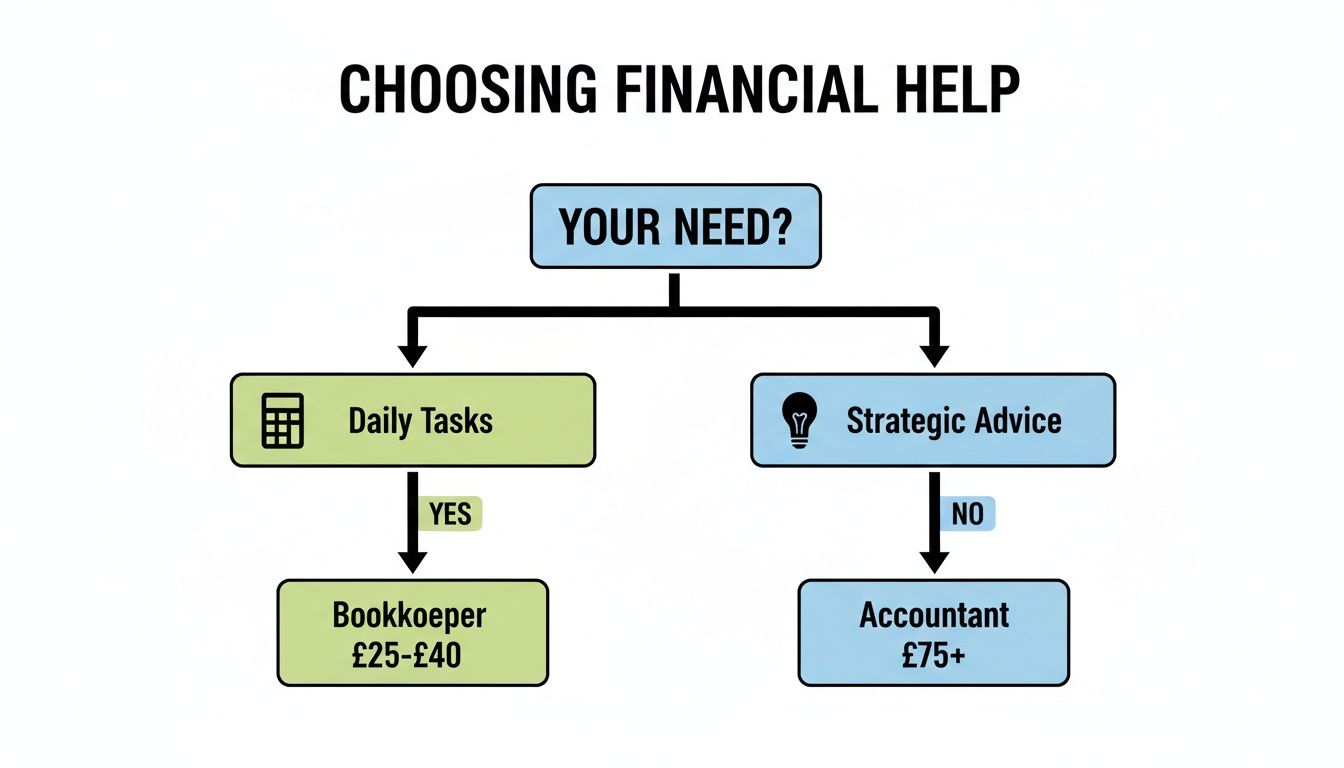
As you can see, routine transactional work is firmly in a bookkeeper’s court. The more complex, advisory stuff demands an accountant's expertise and qualifications.
Assessing Your Contractor Business Structure
Your working arrangement is the biggest factor here. The financial help a contractor needs when working inside IR35 through an umbrella company is worlds away from what a limited company director operating outside IR35 requires.
Let’s look at two typical scenarios for UK contractors.
Scenario 1: The Umbrella Company Contractor (Inside IR35)
If you’re working through a compliant umbrella company, they handle most of the heavy lifting. The umbrella firm is your employer, so they manage all your PAYE tax and National Insurance contributions. Your payroll is their problem, and they ensure you're fully compliant with HMRC.
In this setup, your need for an external accountant is minimal. You might need a bookkeeper for personal finances, like tracking non-claimable expenses or managing other income streams for your Self-Assessment tax return, but that’s about it.
Scenario 2: The Limited Company Contractor (Outside IR35)
Running your own limited company gives you far more control and tax-planning opportunities, but it also saddles you with a hefty administrative and legal burden. For these contractors, having both a bookkeeper and an accountant is almost always the best approach.
A bookkeeper handles the monthly grind:
- Reconciling your business bank accounts.
- Managing invoices and chasing down late payments.
- Preparing and submitting your quarterly VAT returns.
Your accountant then takes this clean, organised data and puts it to work strategically:
- Advising on the most tax-efficient salary and dividend structure.
- Preparing and filing your annual accounts and Corporation Tax return.
- Providing vital advice on how to maintain your outside-IR35 status.
For a limited company director, the bookkeeper keeps the business engine running day-to-day. The Chartered Accountant provides the strategic oversight and compliance checks needed to operate safely and profitably.
Key Questions to Ask Yourself
To get some clarity, ask yourself these direct questions. Your answers will point you towards the right professional, or combination of both, for your specific situation.
What is my business structure?
As we've covered, an umbrella contractor's needs are far simpler than a limited company director's. Your structure dictates your level of financial responsibility.How complex are my transactions?
If you're dealing with a high volume of invoices, multiple clients, and lots of business expenses, a bookkeeper is essential to stop you from getting swamped by admin.Do I need strategic tax advice?
If your goal is to maximise your take-home pay through legitimate tax planning (like pension contributions or timing dividends), you need a qualified accountant. A bookkeeper cannot legally provide this kind of advice.Am I confident about my compliance?
Worried about IR35, VAT rules, or hitting deadlines with Companies House and HMRC? An accountant gives you peace of mind and protects you from expensive penalties.
To help you decide, this checklist breaks down common contractor scenarios and which professional is the best fit.
Decision Checklist: When to Hire Which Professional
This table outlines different situations you might face as a contractor and suggests the best professional support for each.
| Contractor Scenario | Recommended Professional | Key Justification |
|---|---|---|
| New limited company director, unsure of legal duties. | Accountant | Needs strategic setup advice, tax registration (Corp Tax, VAT), and compliance guidance. |
| Overwhelmed with daily invoicing and expense tracking. | Bookkeeper | The core issue is administrative overload, not complex tax planning. |
| Operating inside IR35 via an umbrella company. | Neither (Likely) | The umbrella handles all payroll and tax deductions, removing the need for either. |
| Preparing for end-of-year tax returns and annual accounts. | Accountant | This is a statutory requirement demanding qualified expertise for submission to HMRC. |
| Business is growing, need advice on tax efficiency. | Accountant | Requires strategic advice on dividends, salary, and long-term financial planning. |
| VAT-registered and struggling with quarterly returns. | Bookkeeper | This is a recurring, data-driven task perfect for a bookkeeper to manage. |
| Facing an HMRC enquiry or investigation. | Accountant (Specialist) | Needs an expert with experience in tax law and representing clients to HMRC. |
| Want to start a director's pension for tax relief. | Accountant & IFA | The accountant advises on tax efficiency; an Independent Financial Adviser handles the pension itself. |
| Juggling multiple contracts with different pay structures. | Bookkeeper & Accountant | The bookkeeper organises the data; the accountant provides oversight on the overall tax position. |
This checklist should make it clear that the choice is not just about cost, it's about getting the right skill set for the job at hand.
The rising demand for strategic financial oversight highlights these complexities. Accountancy hiring in the UK surged by 17% in 2025, largely driven by the commercial sector. This trend is even more pronounced in certain regions, with vacancies in the South West jumping by 47% and the West Midlands by 29%. Learn more about these regional hiring trends on morganmckinley.com. For contractors, this shows that while good bookkeeping is always needed, the strategic and compliance assurance an accountant offers is increasingly valued.
By thinking carefully about your structure, workload, and long-term goals, you can choose the right financial expert to support your contracting career. This is not just about admin; it's about building a partnership that frees you up to focus on your work, knowing your finances are in safe hands.
Putting Your Financial Team Together
So, when it comes to the accountant vs bookkeeper debate, it is not really a contest. It is about picking the right specialist for the right job at the right time. Your financial support system is a partnership, and both roles are vital to making your contracting career a success.
Think of your bookkeeper as the one laying the essential groundwork. They’re responsible for the accurate, organised, and up-to-date financial records that everything else depends on. Without that solid foundation, any strategic advice is just guesswork. Their focus on the day-to-day detail keeps the business running smoothly and ensures your data is spot on.
Building on Solid Ground
Your accountant then builds on that foundation. They take the meticulously organised data and provide the strategic insight, tax planning, and compliance assurance you need to grow your business safely and profitably. They interpret the story your numbers are telling and help you write a more successful next chapter.
The best way forward is to see these professionals as indispensable partners on your journey. By letting them play to their respective strengths, you can get on with what you do best, confident that your financial affairs are in expert hands. This collaboration is the key to sustainable growth.
A good way to think about it is like building a house: the bookkeeper is the skilled tradesperson laying a perfect foundation and framing the structure. The accountant is the architect who designed the blueprint and ensures the final build is sound, compliant, and meets your long-term needs.
Is There a Simpler Way?
Of course, managing these relationships still takes time. For many contractors, particularly those whose projects fall inside IR35, there’s often a simpler path. A compliant umbrella company can be an excellent way to take care of your tax and payroll obligations in one go.
At UmbrellaCompany.com, we help contractors find the right setup for their specific circumstances. Using a compliant umbrella service means you hand over most of the admin burden; payroll, tax deductions, and National Insurance are all handled for you. This frees you up to enjoy the flexibility of contracting without the headache of running a limited company, all while ensuring you stay fully compliant with HMRC and maximise your take-home pay.
This summary should help you decide which professional is right for you, but we encourage you to explore our other resources for more detailed guidance.
Frequently Asked Questions
It is only natural to have a few more questions when you're weighing up an accountant vs a bookkeeper. Getting into the practical side of how these roles work is key. Here are the answers to some of the most common queries we hear from contractors.
Do I Need Both an Accountant and a Bookkeeper?
For most contractors running a limited company, the answer is a clear yes. It might feel like you're doubling up on costs, but they perform very different jobs that are equally vital for your business.
Think of it like this: your bookkeeper is on the front lines, handling the high-volume, day-to-day financial data entry. This keeps your records spotless and current. Your accountant then steps in to use that clean data for the big-picture, strategic work, like clever tax planning and filing your year-end accounts. It is a partnership that not only keeps your business running smoothly but often saves you more in tax than you spend on their fees.
Can My Accountant Also Do My Bookkeeping?
Yes, absolutely. Many accountancy firms offer bookkeeping as part of their services, which can feel convenient having everything under one roof. But you need to look closely at the costs.
You'll often find you're paying a premium accountant's rate for what is essentially a bookkeeper's task. For contractors trying to keep a lid on expenses, it’s almost always more cost-effective to hire a specialist bookkeeper for the daily grind and use your accountant for high-level compliance and advice.
At What Point Should I Hire an Accountant?
You should be speaking to an accountant the moment you decide to set up your limited company. Their advice is priceless right from the start.
A good contractor accountant will make sure your company is structured for maximum tax efficiency and that you're registered for everything you need to be, like Corporation Tax and VAT. A common mistake is waiting until the first tax return is due, but by then you’ve likely missed out on tax-saving opportunities. Getting an accountant on board early builds a solid foundation for your entire contracting career.
What Qualifications Should I Always Look For?
This is a brilliant and critical question. For a bookkeeper, you will want to see qualifications from a respected body like the Institute of Certified Bookkeepers (ICB) or the Association of Accounting Technicians (AAT).
When it comes to an accountant, the standards are much higher and the title is legally protected. You should always insist on a Chartered Accountant who is a member of a recognised professional body, such as the ICAEW (Institute of Chartered Accountants in England and Wales) or the ACCA (Association of Chartered Certified Accountants). This is your guarantee that they’ve had rigorous training, are held to a strict code of ethics, and carry professional indemnity insurance, giving you the best protection possible.
At UmbrellaCompany.com, we specialise in helping contractors make sense of these decisions. Our platform lets you compare trusted, compliant umbrella companies to find a solution that takes the headache out of payroll and tax, freeing you up to focus on what you do best. Find the right fit for your career.


