


Figuring out the cost of professional financial advice is a massive step for any UK small business, contractor, or freelancer. So, what should you expect to pay? Generally, accountant rates for small businesses fall somewhere between £25-£150 per hour for one-off jobs, or £100-£300 per month for fixed-fee packages that cover the essentials like tax returns and annual accounts.
Decoding Accountant Rates for Your Small Business

Before you can manage your business finances properly, you need to get a handle on what an accountant should cost. A good accountant does far more than just file your tax returns; they are a partner who can help you stay compliant, make smart decisions, and ultimately, grow your business.
For many contractors and freelancers, the world of accountancy fees can feel a bit murky. But once you break them down, the pricing structures are actually quite straightforward. This guide will give you a clear, no-nonsense overview of typical accountant rates for a small business in the UK.
The Three Main Pricing Models
Most UK accountants stick to one of three main pricing models. Each one is built for different business needs, whether you just need a bit of ad-hoc advice or full, ongoing financial management.
- Hourly Rates: Just what it sounds like. You pay for the time your accountant spends on your work. This is perfect for one-off projects or when you need specific advice on a tricky issue.
- Fixed-Fee Packages: You pay a set price for a bundle of services, usually on a monthly or annual basis. This is by far the most popular choice as it makes budgeting simple.
- Monthly Retainers: A fixed monthly fee gives you continuous access to an accountant for ongoing advice and strategic planning, going well beyond basic compliance tasks.
Here is a quick look at how these common pricing structures stack up against each other.
UK Accountant Pricing Models at a Glance
| Pricing Model | Typical UK Rate Range (2026) | Best Suited For |
|---|---|---|
| Hourly Rate | £25 – £150+ per hour | One-off tasks, specialist advice, or unpredictable, occasional needs. |
| Fixed-Fee Package | £100 – £300+ per month | Businesses wanting predictable costs for core services like tax returns and annual accounts. |
| Monthly Retainer | £300 – £1,000+ per month | Growing businesses needing continuous access to strategic advice and proactive financial management. |
Understanding these options is the first step in figuring out which model offers the best value for your situation. For example, if you are just getting to grips with VAT, checking out our guide on the VAT registration threshold in the UK is a smart move before you even approach an accountant.
Ultimately, we want to lift the lid on the costs involved. The goal is to give you the knowledge you need to choose an accounting partner confidently, so you get the support you need without any nasty surprises down the line.
Choosing Fixed-Fee Packages and Monthly Retainers

For most small business owners and freelancers, knowing what is coming out of the bank each month is non-negotiable. Predictability is king. This is exactly why fixed-fee packages have become the go-to option for ongoing accounting support.
They take the guesswork out of your finances. Think of it like a mobile phone contract: you pay a set fee every month for an agreed bundle of services. It makes budgeting a breeze and stops you from ever having to worry about surprise bills or clock-watching when you need to ask a quick question.
What Does a Fixed-Fee Package Usually Include?
A standard fixed-fee package is all about covering the essentials, the core financial jobs your business needs to get done to keep HMRC happy. While the exact details will vary from one firm to another, most will bundle a similar set of core services.
You can usually expect the basics to cover:
- Annual Accounts Preparation: Getting your yearly financial statements compiled and sorted.
- Corporation Tax Return: Preparing and filing your company's tax return.
- Director’s Self Assessment: Handling the personal tax return for one director.
- Confirmation Statement: Filing that yearly snapshot of your company with Companies House.
- Basic Tax Advice: Access to your accountant for those straightforward queries that pop up.
For most UK small businesses, especially the sole traders who make up a huge slice of the contractor and freelance world, these packages tend to fall in the £100 to £150 per month range. This typically covers your annual Self Assessment return, a bit of tax advice, and sometimes even a subscription to accounting software. You can find more detail on what sole traders can expect to pay at StewartAccounting.co.uk.
Understanding Monthly Retainers
A monthly retainer might sound similar to a fixed-fee package, but there is a key difference in focus. A retainer usually signals a shift from just keeping you compliant to providing proactive, strategic advice.
This model is a better fit for businesses that need more than just the basics. Maybe you want regular management accounts to see how you are really doing, or cash flow forecasts to plan your next move. It is about having those strategic chats that help you make smarter decisions about growth.
A fixed-fee package makes sure you are compliant. A monthly retainer is about getting advisory support to help you plan, grow, and optimise your finances.
In essence, you are paying for consistent access to a financial expert who gets to know your business inside and out. It is a smart move for any business looking to scale up or one that is navigating more complicated financial territory. The right choice simply comes down to what level of support you need right now.
When Hourly Accountant Rates Make Sense
While fixed-fee packages are brilliant for the predictability they offer, not every small business or contractor needs an accountant on speed dial every month. This is where paying by the hour really shines. It is a ‘pay-as-you-go’ model that is perfect for specific, one-off projects or when you need specialist advice without committing to a monthly fee.
Think of it like calling in a specialist tradesperson. You would not keep a plumber on a monthly retainer just in case a pipe bursts, would you? You call them when you have a specific job, pay for their time and expertise, and that is that. An accountant on an hourly rate works in precisely the same way, offering focused support exactly when you need it.
This approach gives you flexible access to a high level of expertise, making it ideal for new businesses still finding their feet or established companies facing an unusual financial puzzle.
Ideal Scenarios for Hourly Billing
So, when does it make the most sense to pay by the hour? The model is particularly effective for well-defined, short-term tasks or complex issues that fall outside the scope of a standard monthly package. It ensures you only pay for the precise work carried out.
Consider paying by the hour for situations like these:
- Business Plan Creation: You need an expert to pull together solid financial projections for a new venture or to secure funding.
- HMRC Tax Investigations: A stressful and complex situation where you need specialist representation and support to navigate it properly.
- Complex Transactions: You are looking for advice on selling your business, acquiring another, or navigating a management buyout.
- Specialised Tax Advice: Getting guidance on intricate areas like Capital Gains Tax, Inheritance Tax, or R&D tax credits.
For contractors and freelancers, one of the most common reasons to hire an accountant by the hour is for a deep dive into IR35 status. Getting an expert contract review or solid advice on your working practices is a prime example of a one-off, high-value task that is perfectly suited to this model.
Understanding the Cost Breakdown
The accountant rates for a small business can vary quite a bit, and it usually comes down to a few key things. The accountant's experience, their qualifications (being a Chartered Accountant makes a difference), and how complex your job is will all play a big part.
Typically, you will find hourly rates in the UK hover somewhere between £25 and £150. Simpler tasks like basic bookkeeping will naturally be at the lower end of that scale. In contrast, complex tax planning or forensic accounting will command a much higher rate.
Most small businesses find that rates between £50 and £150 per hour are pretty common for general ad-hoc advice and support. As the experts at TYY Tax highlight, this range covers various levels of expertise, from routine work to specialist contractor support. You can discover more insights on how these rates vary across the UK at tyytax.co.uk.
Ultimately, paying by the hour offers a transparent and flexible way to manage your costs for specific financial challenges. It ensures you get the right expertise without being locked into a long-term agreement.
Key Factors That Influence Your Accountant Costs
There is no "one-size-fits-all" price tag when it comes to accountancy. Two businesses that look almost identical on the surface can get wildly different quotes, and it is crucial to understand why. The final price you pay really boils down to the unique makeup and complexity of your business.
At the end of the day, an accountant’s fee reflects the time and expertise they need to pour into your finances. The more complex your business, the more work it takes to keep everything accurate and above board. Let's break down the main things that will shape your bill.
Business Structure and Complexity
Your business structure is probably the single biggest factor influencing your costs. A sole trader, for instance, has a much simpler tax life than a limited company, which comes with heavier statutory duties like filing annual accounts with Companies House and handling Corporation Tax.
The nature of your day-to-day operations also plays a massive part. A simple business with straightforward income and expenses is always going to be cheaper to manage than one juggling complex revenue streams, international sales, or a long list of assets. Every extra layer adds to the time your accountant has to spend.
Turnover and Transaction Volume
Your annual turnover is a good shorthand for the scale of your business. More revenue usually means more transactions, and each one needs to be processed and reconciled. An accountant managing a high volume of invoices, receipts, and payments simply has more work on their plate.
The sheer volume of financial activity is a key cost driver. A business with 50 transactions per month requires significantly less bookkeeping effort than one with 500, regardless of their industry. Keeping your records clean and organised from the start is a great way to keep these costs down.
Additional Compliance Requirements
Beyond your basic business structure, a few other compliance needs can bump up your accounting costs. These often demand specialist knowledge and a lot more admin.
Here are the key services that tend to add to the bill:
- VAT Registration: If your business is VAT registered, your accountant will need to prepare and file your quarterly VAT returns with HMRC. This is a significant, ongoing task.
- Payroll Services: Taking on staff means you need payroll. This involves managing PAYE, National Insurance contributions, pensions auto-enrolment, and sending regular reports to HMRC.
- Bookkeeping Quality: The state of your records really matters. If you hand over neat, organised books, your accountant can get straight to work. Disorganised or incomplete records mean they have to spend extra hours just tidying everything up, and that time will be reflected in your bill. For a deeper dive, our guide on limited company accountant fees has more detail.
DIY Accounting Software vs Hiring a Professional
With so many powerful digital tools out there, it is a fair question for any small business owner to ask: can I just handle the finances myself? Modern accounting software certainly presents a tempting alternative to hiring a pro, but is it the right move for your business? Let's break it down.
These days, accounting software from providers like Xero or QuickBooks is incredibly user-friendly and affordable. It gives you a real-time pulse on your cash flow, automates the tedious parts of invoicing, and makes reconciling your bank account a breeze. This hands-on control is empowering, letting you make quick, informed decisions on the fly.
When Software Just Is Not Enough
But here is the thing: software is a tool, not a strategist. It is brilliant at telling you what you have spent, but it cannot advise you on where you should be investing. It will track your tax liabilities down to the penny, but it has no idea how to legally minimise them.
Relying solely on software is a bit like using a standard legal template for a complex contract. It covers the basics, but it completely misses the nuances and potential pitfalls that an expert would spot in a heartbeat.
A professional accountant brings value that goes far beyond simple data entry. Their real expertise lies in strategic tax planning, keeping you compliant with ever-changing HMRC regulations, and offering tailored advice on tricky issues that software cannot possibly compute. They become a financial partner, helping you navigate growth, secure funding, or structure your business in the most tax-efficient way.
This flowchart highlights some of the key business factors that swing the decision one way or the other.
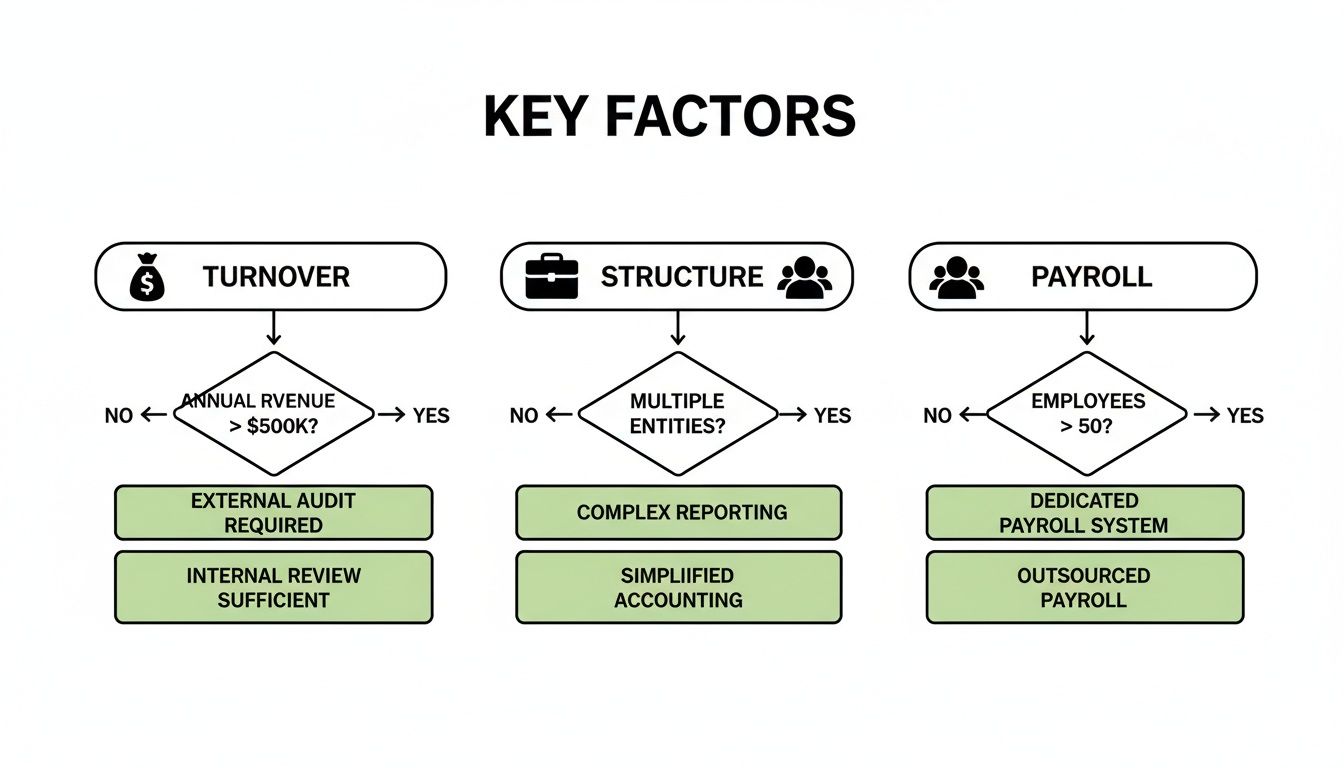
As you can see, things like your business turnover, company structure, and whether you have employees are major decision points when figuring out the level of accounting support you need.
Making the Right Choice for Your Business
Choosing between DIY software and a professional accountant really boils down to your business’s complexity, your own confidence with numbers, and your ambitions for the future.
This table helps weigh up the pros and cons of managing your own books versus bringing in an expert.
Comparing DIY Software vs a Professional Accountant
| Aspect | DIY Accounting Software | Hiring a Professional Accountant |
|---|---|---|
| Cost | Low monthly subscription fees. | Higher upfront cost (hourly, fixed, or retainer). |
| Time Commitment | Requires your personal time for data entry, reconciliation, and reporting. | Frees up your time to focus on core business activities. |
| Expertise | Relies entirely on your own financial knowledge. | Provides expert strategic advice, tax planning, and compliance. |
| Scope | Best for day-to-day bookkeeping, invoicing, and basic financial tracking. | Handles complex tax returns, financial forecasting, and strategic growth advice. |
| Risk | Higher risk of errors, missed deductions, or non-compliance. | Mitigates risk by ensuring accuracy and adherence to regulations. |
| Best For | Sole traders, freelancers, and very simple businesses with low transaction volume. | Limited companies, businesses with employees, VAT-registered entities, and those planning to scale. |
Ultimately, there is not a single right answer for everyone. A simple sole trader business with a handful of transactions each month might do just fine with software alone. But a growing limited company with employees and VAT obligations? That almost certainly needs professional oversight.
Consider these final points:
- Complexity: The more moving parts your business has (employees, stock, VAT) the stronger the case for hiring an accountant becomes.
- Time vs Money: What is your time really worth? While a software subscription is cheap, the hours you sink into bookkeeping could be better spent winning new clients and growing your business.
- Growth Ambitions: If you have big plans to scale, an accountant’s strategic input is invaluable. They provide the financial roadmap that software simply cannot generate.
While software is fantastic for managing the day-to-day, a human expert provides the strategic guidance needed for long-term success. If you are exploring software options to get started, our guide on the best invoicing software for contractors can offer some helpful pointers.
How to Find the Right Accountant for Your Budget
Choosing an accountant is one of the most important decisions you will make for your business. This is not just about crunching numbers; it is about finding a genuine partner who can add real value and help you grow. With a bit of a plan, you can find the right expert without breaking the bank.
Your first port of call should always be the professional bodies. Look for accountants accredited by organisations like the Association of Chartered Certified Accountants (ACCA) or the Institute of Chartered Accountants in England and Wales (ICAEW). This membership is your guarantee that they are properly qualified and held to high professional standards, which gives you crucial peace of mind.
Asking the Right Questions
Once you have got a shortlist, the initial consultation is your chance to see if they are a good fit. Think of it as a two-way interview. Do not be shy about asking direct questions about their experience, their fees, and how they work with businesses like yours.
It pays to be prepared. Jot down a few key questions before you meet:
- What are your specific accountant rates for a small business like mine?
- Do you specialise in working with contractors, freelancers, or my particular industry?
- What is actually included in your fixed-fee packages, and what counts as an extra?
- Which accounting software do you use or prefer?
- Who will be my day-to-day contact at your firm? Is it you or a junior?
Finding someone who genuinely gets the challenges of your world is vital. For contractors, for example, an accountant who is not a specialist in IR35 is a complete non-starter. Our guide on choosing the best accountant for limited company contractors has more specific advice on this.
Understanding the Engagement Letter
Before you sign on the dotted line, you will receive an engagement letter. Pay close attention to this. It is the formal contract between you and your accountant, and it sets out exactly what they will do, what their responsibilities are, and what is expected of you.
Go through the engagement letter with a fine-tooth comb. It should clearly spell out the pricing structure, payment terms, and any other costs that might pop up. This level of transparency is the hallmark of a professional firm and your best defence against surprise bills later on.
Finally, do your homework before your first official meeting. Get your business and financial documents organised and in one place. The more prepared you are, the more you will get out of the session. A proactive start like this lays the groundwork for a strong, valuable partnership.
Your Questions Answered
When you are trying to figure out accountant costs for your small business, a few common questions always pop up. Let's get them answered so you can feel confident about your next move.
What Does a Standard Accountant Package Actually Include?
Think of a standard fixed-fee package as your core compliance sorted. While the specifics can vary between firms, you can usually expect it to cover the essentials for a limited company.
This typically means preparing and filing your annual accounts with Companies House and your Corporation Tax return with HMRC. Most will also handle your yearly Confirmation Statement and one director's personal Self Assessment tax return. On top of that, you will often get a bit of ad-hoc advice for quick questions over the phone or email, so you are not left in the lurch.
When Is the Right Time for My Business to Hire an Accountant?
Honestly, it is probably sooner than you think. The main signal is when the finances start feeling like a real chore, eating into the time you should be spending on growing the business.
Look out for these key milestones:
- You have just registered as a limited company. This brings a whole new level of filing obligations.
- You are getting close to the VAT threshold. This is your cue to get serious about managing and filing VAT returns correctly.
- You are about to hire your first employee. Welcome to the world of payroll and PAYE.
Bringing an accountant on board at these stages helps you navigate the complexity and get it right from day one.
How Can I Tell if I’m Paying Too Much for My Accountant?
A good way to gauge this is to benchmark what you are paying against the typical market rates we have discussed. For a straightforward limited company, a fixed-fee package should land somewhere between £100 and £300 a month.
If your bill is significantly higher, take a moment to look at the value you are getting. Is your accountant giving you proactive business advice, sending regular management reports, or helping with specialised services like R&D tax credits? If you are paying a premium but only getting basic compliance, it might be time to shop around and see what other firms can offer.
Finding the right support at the right price is a massive part of getting your business to thrive. At UmbrellaCompany.com, we help contractors and freelancers compare and connect with trusted, compliant solutions built for them.
Ready to explore your options? Visit us at https://umbrellacompany.com.


