


You've just incorporated your first limited company. Companies House wants filings, HMRC wants records, and your client wants you focused on delivery rather than bookkeeping. A spreadsheet may handle straightforward expenses, but it won't necessarily tell you whether your payroll, VAT, dividends, IR35 evidence, or year-end obligations are working together properly.
That's where accountancy services for contractors earn their place. The right service isn't a generic monthly package. It should match whether you work through an umbrella company, as a sole trader, or through your own personal service company (PSC), and it should change as your contracts and responsibilities change.
Who This Guide Is For and What You Will Learn
This guide is for UK contractors who've recently gone limited, are considering a PSC, work as sole traders, or have moved into an umbrella arrangement. It's also for freelancers deciding how to approach their first engagement and wondering whether specialist support is worth the cost.
The short answer is that an accountant can be unnecessary for one working pattern and essential for another. An umbrella employee generally needs help checking deductions and payslips, while a PSC director may need payroll, VAT, corporation tax, annual accounts, dividend planning, self assessment, and IR35 support.
By the end, you'll be able to:
- Identify the right service tier: Separate the support you need from attractive but irrelevant extras.
- Compare fee structures: Understand what a fixed monthly fee, modular package, or separate review covers.
- Test provider quality: Check accreditation, professional supervision, software compatibility, insurance, and service standards.
- Understand the 2026 changes: See why the April 2026 off-payroll threshold changes should alter the questions you ask your accountant.
- Protect your records: Know what to review on payslips, VAT returns, payroll reports, and IR35 evidence packs.
Practical rule: Choose an accountant for the decisions they'll help you make, not simply for the forms they'll submit.
The most useful provider will ask how you work before recommending a package. They'll want to know whether you invoice through a PSC, receive PAYE payslips from an umbrella, use the Construction Industry Scheme, charge VAT, work inside or outside IR35, and expect your contract pattern to change.
That conversation is more valuable than a low headline price. Contractor accounting works best when payroll, bookkeeping, tax planning, status reviews, and statutory filings form one organised process.
The Core Accountancy Services Available to Contractors
Think of compliance as a set of MOT checks. Payroll catches one type of problem, VAT catches another, and annual accounts close the loop. A contractor accountant should connect those checks rather than treat each filing as an isolated transaction.
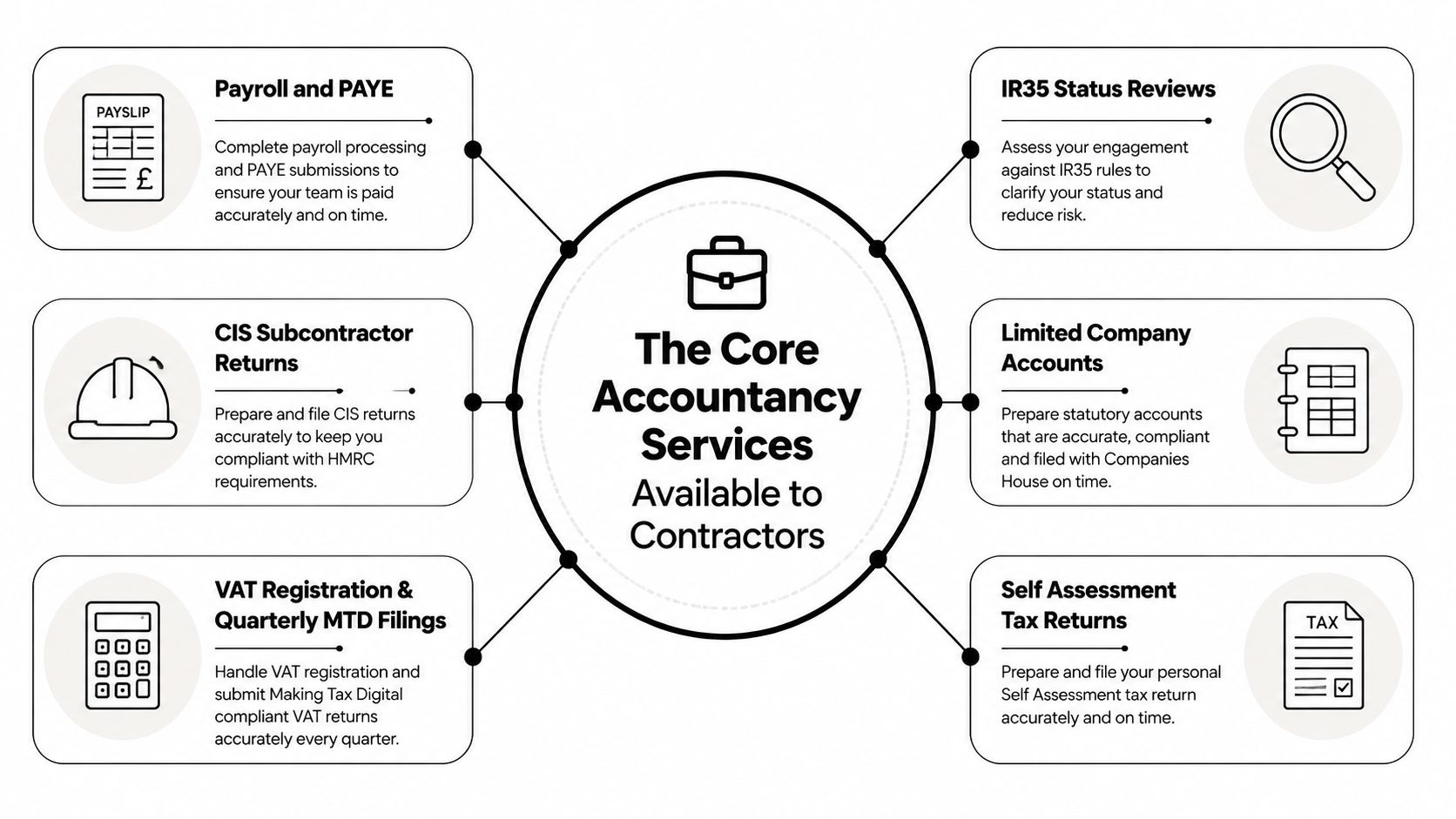
Payroll and PAYE
Payroll covers salary processing, PAYE reporting, National Insurance, payslips, and year-end payroll documents. For a PSC, that may mean a director's salary and payroll submissions. For an umbrella employee, the umbrella normally operates PAYE and provides the payslip.
CIS and VAT
CIS subcontractor returns matter to contractors in construction who pay subcontractors. The return needs accurate deduction records and timely reporting.
VAT registration and quarterly Making Tax Digital filings sit on top of clean bookkeeping. A contractor accountant should reconcile invoices, purchase records, VAT treatment, and digital records before submission. Sole traders whose turnover exceeds £90,000 must register for VAT under the stated threshold rules, as set out in the relevant HMRC VAT registration guidance.
IR35 and tax planning
An IR35 status review should examine the written contract and working practices, then preserve the reasoning in an evidence pack. HMRC's off-payroll working guidance explains how responsibility can sit with the engager or fee payer, depending on the engagement.
Year-end tax planning then turns that information into decisions about expenses, salary, dividends, pension contributions, and cash reserves. The advice must reflect how you work, not a template designed for another business.
Accounts and self assessment
Finally, statutory annual accounts and self assessment report the results to Companies House, HMRC, and the individual taxpayer where required. Monthly bookkeeping feeds every other service, so the order matters: payroll first, CIS in parallel, VAT on top, IR35 and tax planning throughout the year, then accounts and tax returns.
If you're comparing providers or looking at wider finance support, you can also find accounting tenders to understand how firms describe their services and requirements. For a contractor-focused overview, see accounting for contractors.
Matching Services to Your Working Pattern
There isn't one correct contractor accounting package. Your working pattern determines where the work sits and where professional support adds value.
| Service | Umbrella employee | Sole trader | Limited company PSC |
|---|---|---|---|
| Payroll and PAYE | Run by the umbrella, review payslips | Usually unnecessary unless employing staff | Director payroll and PAYE |
| CIS submissions | Usually handled within the employment route | Relevant when paying subcontractors | Relevant when paying subcontractors |
| VAT and MTD | Usually not your responsibility | Registration and quarterly filings where applicable | Registration and quarterly filings where applicable |
| IR35 review | Check the engagement and umbrella chain | Review status where relevant | Core service, with evidence pack |
| Annual accounts | Not normally required personally | Business records support tax return | Statutory accounts and corporation tax |
| Self assessment | Personal return only where required | Core annual filing | Director's personal return where required |
| Main cost area | Often limited to checking pay and deductions | Returns, bookkeeping, and VAT | Full compliance and advisory package |
Umbrella employees
If an umbrella company employs you, it generally runs payroll, CIS and VAT obligations connected to its own operation. HMRC says the off-payroll rules are unlikely to apply to the worker directly where the umbrella is the employer and operates PAYE.
Your practical need is different. Check the assignment rate, employer costs, pension treatment, holiday pay, tax code, National Insurance, margin, and every deduction on your payslip. From 6 April 2026, new rules are set to introduce joint and several liability for PAYE and National Insurance in umbrella supply chains, meaning agencies and, in some cases, end clients may face recovery action if an umbrella fails to operate payroll correctly. HMRC's umbrella company guidance should form part of your due diligence.
Sole traders
A sole trader usually needs bookkeeping, self assessment, tax planning, and CIS support if they pay subcontractors. VAT advice becomes important where registration applies, and quarterly digital filing responsibilities need to be built into the workflow rather than treated as a year-end surprise.
Limited company PSCs
A PSC needs the broadest package. Expect director payroll, VAT where registered, corporation tax, statutory accounts, confirmation statement support, dividend records, self assessment, and IR35 reviews. Specialist accountancy services for contractors typically provide the strongest practical value here, because one missed decision can affect several filings at once.
Pricing Models and What You Actually Pay For
Contractor accountants commonly charge through four models. Public comparison guidance places contractor-accountant pricing around £60 to £200 or more per month, with the actual fee depending on structure, filing volume, advice, and service depth. See the guidance on accountant fees for contractors when comparing quotes.
| Model | Typical cost | Included as standard | Watch out for |
|---|---|---|---|
| Fixed monthly fee | £60 to £200+ per month | Agreed compliance package and routine contact | VAT, payroll extras, investigations, and advisory work may cost more |
| Percentage of turnover | Often quoted as a percentage | Services linked to revenue level | The fee rises even when the work remains similar |
| Modular bundle | Varies by selected services | Separate bookkeeping, payroll, VAT, and returns | Important compliance tasks can sit outside the base bundle |
| Bespoke IR35 review | £150 to £500 per review | Contract analysis and written advice | A cheap package may omit evidence preparation or working-practice analysis |
The fixed-fee model is easiest to budget, but read the engagement letter carefully. Ask whether the price includes VAT returns, payroll per employee, dividend paperwork, confirmation statements, Companies House filings, software, phone support, and HMRC correspondence.
Percentage pricing can suit a business with fluctuating complexity, but it may not reflect the accountant's actual workload. A modular bundle gives you control, although contractors sometimes select the cheapest modules and leave out the work that prevents problems.
A separate IR35 review can be sensible for a one-off contract. A PSC with repeated engagements usually needs a repeatable review process, not an isolated opinion that sits in a folder.
The key trade-off is between compliance processing and proactive advice. Bare-bones online providers may file accurately when you give them complete records. A more involved adviser should challenge your assumptions, review extraction plans, flag weak evidence, and help you prepare before deadlines. Match the pricing structure to your contract length, income pattern, and appetite for managing the detail yourself. The breakdown of accountant fees can help you identify what a quoted package leaves out.
Vetting an Accountancy Provider the Right Way
A polished website proves very little. If you have just formed a PSC or moved to an umbrella, verify the provider's status and test how it works before you hand over responsibility.
For umbrella services, FCSA and Professional Passport are useful reference points. Check the provider's current listing directly rather than relying on a badge in a sales presentation. FCSA membership includes requirements around identifying the employer PAYE reference on payslips, while recognised standards support consistent compliance checks and clear operating practices.
For an accountancy firm, ask which professional body supervises the practice. ICAEW, ACCA, and AAT are recognised names, but verify the firm or individual on the relevant register. HMRC's online services can also help confirm details connected with tax-agent authority and payroll activity.
The fifteen-minute provider check
- Confirm accreditation: Search the current FCSA or Professional Passport listing if the provider claims accreditation.
- Check supervision: Verify registration with ICAEW, ACCA, AAT, or another recognised supervisory body.
- Request a sample payslip: For umbrella work, check that the employer identity and PAYE details are clear.
- Test software compatibility: Ask whether the bookkeeping and VAT systems support Making Tax Digital requirements.
- Ask about insurance: Confirm the scope of Professional Indemnity insurance and whether it covers contractor tax and status advice.
- Read the fee schedule: Look for separate charges for VAT registration, CIS submissions, payroll amendments, dividends, and HMRC enquiries.
- Identify your contact: Establish who handles technical questions and what happens during their absence.
For umbrella workers, compare the payslip with the assignment statement. Ask the provider to explain employer National Insurance, employee deductions, pension, holiday pay, and the umbrella margin. LITRG explains that legitimate umbrella pay should run through PAYE. Its guidance for umbrella company workers is a useful independent reference, and HMRC's online tools can help you check whether pay and deductions appear correct.
Before signing, work through a structured due diligence process and read the engagement letter, data-protection terms, response commitments, complaints process, and termination provisions. If the provider cannot explain its fees or gives vague answers about payroll, walk away.
How 2026 Rules Change the Service You Need
From 6 April 2026, the UK small-company thresholds for the off-payroll rules are set to rise to turnover up to £15 million and a balance sheet total up to £7.5 million, according to the IR35 reform information published by ContractorUK. That change can bring more medium-sized engagers into the regime where the engager, rather than the PSC alone, must assess off-payroll status.
The practical effect is significant. Your accountant shouldn't just tell you whether a contract “looks inside” or “outside” IR35. They should help identify who has the determination duty, whether the Status Determination Statement is valid, how disagreements are handled, and what evidence supports the conclusion.
What proactive support looks like
A competent adviser should be ready to:
- Review affected contracts: Check terms, substitution rights, control, mutuality, and the actual working relationship.
- Prepare evidence packs: Preserve the contract, SDS, CEST output where used, correspondence, and working-practice notes.
- Update templates: Make sure new contracts and engagement documents reflect the correct responsibility allocation.
- Monitor the fee payer: Confirm that PAYE and employee National Insurance deductions are made by the correct party where required.
- Coordinate the supply chain: Ask how the agency, end client, PSC, and umbrella fit together.
From 6 April 2026, umbrella-company tax rules are also set to create joint and several liability for PAYE and National Insurance in relevant supply chains. This raises the importance of checking the umbrella's payroll controls, records, PAYE reference, and compliance history before accepting an assignment.
Your accountant should contact you before the change affects an active contract. Ask, “Who is responsible for the status determination?”, “Where is the evidence?”, “Who is the fee payer?”, and “What happens if the umbrella or agency fails to operate PAYE correctly?” The explanation of the IR35 and off-payroll reforms can help you prepare for that conversation.
The following video provides additional context on the rule changes:
Two Contractor Stories That Bring It Together
Mark, a London-based IT contractor, paid £250 per month for limited company accounts and self assessment only. His accountant wasn't reviewing IR35, VAT opportunities, or the way he claimed business expenses. After moving to a tiered package, Mark paid £140 per month and reclaimed more than £3,200 in overlooked expenses during his first year.
The lesson wasn't that the cheaper monthly fee always wins. It was that Mark had been paying for the wrong shape of service.
Sara, a construction contractor, chose an online provider charging £45 per month. The provider missed paperwork connected with her CIS gross payment status. HMRC opened an enquiry, which led to £1,800 in penalties and a six-month cashflow problem.
These examples show why price must be judged against relevance. Mark needed a PSC service with reviews and planning, not a filing-only package. Sara needed construction-aware CIS support and someone responsible for checking the paperwork before it became an HMRC issue.
The right tier may cost more than a basic online service, but an irrelevant package can cost more overall. Ask which risks the accountant actively manages, then compare that answer with your actual working pattern.
Choosing Well and Next Steps
Before signing an engagement letter, confirm five points.
- Accreditation and supervision: Check FCSA or Professional Passport where relevant, and verify the accountancy practice with a recognised professional body.
- A working-pattern fit: Make sure the package reflects umbrella employment, sole-trader work, or PSC responsibilities. Don't pay for services you can't use.
- Proactive IR35 advice: Expect contract reviews, evidence trails, and clear advice about the April 2026 off-payroll changes.
- A named qualified contact: Ask who will advise you and whether they hold a relevant ICAEW, ACCA, AAT, or ATT qualification.
- Transparent fees: Get written confirmation of charges for CIS, VAT, payroll amendments, dividend paperwork, HMRC correspondence, software, and investigations.
A good accountant should make your position clearer, not bury you in jargon. They should also help you plan before a deadline, rather than explain a problem after HMRC has raised a query.
For umbrella workers, that may mean payslip and deduction checks. For sole traders, it may mean reliable CIS, VAT, and self assessment support. For PSC directors, it should include joined-up payroll, tax planning, IR35 evidence, accounts, and corporation tax work.
The right accountant can pay for themselves through better decisions and fewer compliance failures. Start with your working pattern, list the tasks you currently handle, and ask each provider to map its service directly to that list.
Umbrella Company helps contractors compare umbrella providers and find support suited to their working pattern, pay arrangements, and IR35 position. Visit Umbrella Company for guidance and a free initial comparison of service tiers suited to your structure and turnover.


