


Starting your own limited company often feels like a clean break. You have more control, your contract income lands in the business, and you can run your work in a more structured way.
Then the admin appears.
You start seeing terms like Corporation Tax, Self Assessment, VAT, payroll, and IR35. At the same time, accountants quote very different prices for what sounds like similar help. One firm talks about a low monthly fee. Another offers an annual package. A third says everything is included, until you ask about VAT or contract reviews.
That confusion is normal.
If you have recently incorporated, this guide will help you make sense of accountancy costs for ltd company arrangements in the UK. We will look at what drives the price, what should be included, where extra charges often appear, and how the numbers compare with the simpler umbrella route.
A clear decision now can save a lot of stress later. If you are still at the early stage, it also helps to understand how much it can cost to set up a limited company before you compare ongoing accountancy support.
Introduction Navigating Your First Year as a Ltd Company Director
Your first year as a company director is rarely expensive because of one single bill. It becomes expensive when small compliance tasks get missed, rushed, or handled by the wrong person.
That is why the cheapest quote is not always the cheapest outcome.
A contractor’s limited company is usually straightforward compared with a large trading business, but it still has moving parts. You need accounts prepared properly, tax returns filed on time, payroll handled correctly, and records kept in a way that matches HMRC expectations. If you are VAT registered, the admin increases. If IR35 enters the picture, the stakes rise again.
Many freelancers try one of three routes at the start:
- DIY software only, hoping the platform will cover every decision
- A general local accountant, who may be solid on small business basics but not specialist contractor issues
- A contractor-focused accountant, who understands the usual pain points from day one
The third option is usually the one that causes the fewest headaches.
Software is useful, and we will come back to that. But software does not decide whether a contract needs closer IR35 attention. It does not explain how to deal with mixed outside and inside IR35 work. It also does not always tell you whether the low monthly fee excludes the very services you need.
Why a Specialist Contractor Accountant is a Critical Investment
A common first-year mistake goes like this. You set up your company, pick low-cost software, assume the admin will stay simple, then a client asks about IR35, an agency pays you in an unexpected way, and you are suddenly making tax decisions without much context.
That is the point where a specialist earns their fee.

A general accountant may be perfectly capable with small business accounts. A contractor accountant usually understands the patterns that trip up freelancers with limited companies. That includes project-based income, agency chains, one-person payroll, dividend timing, and contracts that may shift between outside and inside IR35 during the year.
If you are weighing up providers, start with firms that work with contractors every day. This guide to the best accountant for limited company contractors is a useful place to compare specialist options.
Where a specialist adds real value
Your company may be small, but the decisions are linked. Salary affects payroll. Dividends depend on profit. Expenses need to be valid and recorded properly. VAT changes how you invoice and report. IR35 can alter whether running a limited company still gives you an advantage over an umbrella company.
That last point is often missed.
If most of your work ends up inside IR35, the extra company admin and accountancy costs can start to look poor value compared with the simplicity of umbrella employment. If your contracts are outside IR35, a limited company can still work well, but only if it is run correctly. A specialist accountant helps you judge that trade-off with your eyes open, rather than assuming Ltd is always the better route.
They also tend to be sharper in areas such as:
- IR35 handling, including changes in contract status during the year
- Director remuneration, so salary and dividends are planned sensibly
- Allowable expenses, so you avoid both overclaiming and underclaiming
- Agency and client admin, which affects how income reaches your company
- Bookkeeping setup, so records are clean before problems build up
Why contractor knowledge saves money
The fee is only one part of the cost.
A specialist often saves money by preventing avoidable errors early. That might mean spotting that you should register for VAT sooner, warning you that a contract needs review, correcting how you take money from the company, or explaining when the umbrella route may be simpler and cheaper overall.
That is similar to paying for a good site manager on a building job. You are not only paying for paperwork. You are paying to stop expensive mistakes before they happen.
Software helps, but judgement matters more
Cloud tools such as Xero and QuickBooks are useful. They record transactions, store receipts, and keep the books tidier.
They do not decide whether a contract creates IR35 risk. They do not explain the practical difference between a low-fee annual accountant and a contractor package with ongoing advice. They also do not help much with the bigger decision many freelancers face. Should you keep trading through your Ltd company, or would an umbrella company leave you with less admin for a similar net outcome?
For a very simple company, software plus minimal support may be enough. For a working contractor with changing assignments, regular advice is usually what keeps costs under control.
Decoding Accountant Fee Structures Monthly vs Annual Packages
Most quotes for accountancy costs for ltd company support fall into two camps. You either pay a fixed monthly fee, or you pay an annual charge for year-end work, with extras added as needed.
Neither model is automatically wrong. The right one depends on how active your company is and how much support you want during the year.
Why monthly packages became the norm
For many contractors, monthly pricing suits the way limited companies now operate.
You are not just buying year-end accounts. You are buying regular compliance handling, software access, tax reminders, payroll submissions, and someone to answer questions before a mistake becomes expensive.
Monthly pricing also makes budgeting easier. You know what is leaving the company bank account each month, which is useful when income is strong in some months and quieter in others.
When an annual package can still work
An annual package may suit you if your company is very simple.
For example, you might have:
- one director
- no VAT registration
- no employees
- low transaction volume
- no complicated status issues during the year
Even then, you need to read the scope carefully. Some annual packages cover accounts and tax returns only. Day-to-day advice, payroll, software, or director Self Assessment may be extra.
A practical way to compare quotes
Do not compare accountants by headline price alone. Compare them by what is included, when support is available, and how they charge for anything outside the package.
Use this simple filter.
| Fee model | Usually suits | Main strength | Main risk |
|---|---|---|---|
| Monthly fixed fee | Active contractors who want support throughout the year | Predictable cost and ongoing help | Can look higher if you only compare the monthly headline |
| Annual package | Very simple companies with minimal activity | May work for basic year-end compliance | Extra charges can build up if you need advice, VAT, or payroll support |
Core work versus bolt-on charges
The easiest way to avoid a poor-value package is to split every quote into two parts:
- Core compliance, the work every ltd company needs
- Extras, the work triggered by how your company operates
Core items often include accounts, Corporation Tax return, payroll for the director, and personal tax return support.
Extras often include bookkeeping cleanup, additional payroll, VAT registration help, IR35 contract support, and ad hoc advice beyond a fair usage limit.
Key takeaway: A low monthly fee is only good value if it covers the work your company needs.
What Accountancy Packages Should Include Core Services vs Paid Extras
You sign up for an "all-inclusive" package at a low monthly fee. Three months later, you discover VAT returns cost extra, your Self Assessment is not included, and each IR35 question triggers a separate bill. That is a common first-year mistake for new company directors.
The fix is simple. Read every package as if you were checking what is included in a mobile phone contract. The headline price matters, but the allowance matters more.
A good contractor package should cover the recurring work that keeps your company compliant and usable through the year. For many freelancers, that means the accountant is not just filing year-end forms. They are also helping you run the company month by month without small admin problems turning into expensive clean-up work.
What should usually sit in the core package
For a typical one-director contractor company, the core package will often include:
- Annual accounts preparation
- Corporation Tax return
- Director payroll
- Director’s personal tax return
- Online accounting software access
- Routine support by email or phone
- VAT returns, if you are VAT-registered and the quote is for a VAT-registered company
- Basic IR35 support, if the firm specialises in contractors
If several of those items are missing, the package may still be usable, but you need to price the gaps before comparing it with another quote.
That point matters even more if you are choosing between a limited company and an umbrella company. Umbrella fees are usually easier to understand because employment admin is wrapped into one arrangement. A limited company can still work out better value, but only if you know which accountancy tasks are already covered and which ones will be billed on top.
Standard Accountancy Package Inclusions vs Common Extras
| Service | Typically Included in Core Package? | Typical Extra Cost Range |
|---|---|---|
| Annual accounts | Usually yes | Often bundled |
| Corporation Tax return | Usually yes | Often bundled |
| Director payroll | Usually yes | Sometimes charged if not included |
| Director personal tax return | Often yes | Sometimes charged separately |
| VAT returns | Sometimes, depends on package | May be charged separately |
| Cloud accounting software | Often yes | Sometimes charged separately |
| IR35 support | Sometimes | May be charged separately |
| Bookkeeping cleanup | Often no | Usually charged separately |
| Tax return work outside the standard package | Often no | Usually charged separately |
| Additional employee payroll | Often no | Usually charged separately |
| Company formation support | Sometimes | Can be part of a setup package |
Where extra charges usually appear
Extra charges tend to show up in the areas where one contractor differs from another.
A contractor with clean records, one bank account, one payroll run, and straightforward expenses is easier to handle than a director who mixes personal and company spending, uploads paperwork late, or needs frequent tax advice. The second company is not doing anything wrong. It creates more work.
Common paid extras include:
- Bookkeeping catch-up or clean-up
- Payroll for employees beyond the director
- VAT registration or deregistration help
- Flat Rate Scheme advice
- Detailed IR35 contract reviews
- Year-end corrections from poor records
- Mortgage references, letters, and ad hoc certificates
- Tax planning outside routine support
These extras are not always a warning sign. Some are perfectly reasonable to bill separately because not every contractor needs them. The problem starts when a low fee excludes services that most limited company directors will almost certainly use.
Two freelancers can pay very different amounts
An IT contractor with one client, regular invoices, tidy bookkeeping, and no staff is usually a simpler case.
A designer or marketing freelancer with many smaller invoices, irregular expenses, VAT, subcontractor costs, and contracts that raise IR35 questions often needs more help during the year. Similar turnover does not always mean similar accountancy work.
That is why package design matters. One quote may look cheaper until the extras are added back in.
Red flags in cheap packages
Be cautious if a package leaves out several of these items:
- Software subscription
- Director Self Assessment
- VAT return preparation
- Payroll
- Phone or email support
- Year-end adjustments
- IR35-related help
A quote like that can still suit a very simple company. For many active contractors, it is the accountancy version of buying a tool kit and finding half the tools are sold separately.
Tip: Ask for two written lists before you sign up. First, what is included in the monthly fee. Second, what triggers an extra charge. If the answers are vague, the package price is vague too.
Accountancy Costs for a UK Ltd Company in 2026
You set up your company to keep more of what you earn. Then the first accountant quotes arrive, and the gap between them can look oddly wide. One firm wants a modest monthly fee. Another is much higher. A third looks cheap until you notice several common jobs are extra.
For a typical UK limited company contractor, monthly accountancy fees often fall somewhere between the lower and upper hundreds, with simpler companies nearer the bottom of that range and busier, advice-heavy companies nearer the top. As noted earlier, the monthly model is common because limited company compliance is rarely a once-a-year job.

A useful way to budget is to place your company into a working tier before you compare firms.
| Type of ltd company setup | Likely position in the market range | Why |
|---|---|---|
| Very simple, low-admin contractor company | Lower end | Few transactions, no special reporting, little ongoing advice |
| Typical active freelancer or consultant | Middle of the range | Regular compliance work plus routine support during the year |
| More complex contractor setup | Upper end or above | More admin, more review work, and more judgement calls |
That table matters because accountancy pricing is not only about turnover. It is about workload and risk.
A one-director IT contractor with one main client and tidy records is usually straightforward to handle. The accountant still has important compliance work to do, but there are fewer moving parts to monitor. In practice, that kind of company often needs a standard monthly package with annual accounts, Corporation Tax filing, payroll, Self Assessment support, software, and help with routine questions about expenses and dividends.
Now compare that with a creative consultant who bills several clients, is VAT registered, has a broader spread of costs, and wants help keeping contracts and records clean throughout the year. The fee rises because the accountant is reviewing more entries, answering more questions, and spending more time checking that everything is treated properly. Similar income does not always mean similar accountancy effort.
There is also a practical comparison many new contractors miss. A limited company usually gives you more control and can work out better financially in the right circumstances, but it comes with a separate accountancy bill. An umbrella company wraps much of that admin into one ongoing fee and a simpler payslip model. Therefore, the question is not only, "What does a ltd company accountant cost?" It is, "Does the extra admin and fee still leave me better off than using an umbrella?"
Three things usually push a quote upward:
- More filing and reporting work
- More transactions to review and code
- More judgement-based support, especially if contracts or tax treatment need closer attention
Some firms also charge more because they provide a more hands-on service, with faster replies, proactive tax planning, or broader year-round support.
If a quote sits above your expected range, ask the accountant to break it down in plain English. A fair fee should have a clear reason behind it. If they can explain the work, you can judge the value.
How VAT Payroll and IR35 Affect Your Accountancy Fees
Most contractors start with a base package in mind, then discover that the price depends on how the company operates.
The biggest fee drivers are not mysterious. They come from extra processing, more reporting, and more risk.
VAT adds regular reporting work
Once your company is VAT registered, your accountant is usually doing more than year-end compliance.
They may need to review records more often, check transaction coding, prepare VAT returns, and make sure the filing process fits HMRC’s digital requirements. That is one reason monthly accountancy support became more common for active limited companies.
The admin is not just technical. It is also routine. A repeated task every quarter creates a different workload from an annual-only company.
Payroll becomes more involved when your setup grows
A single-director payroll is usually built into many contractor packages.
Fees can rise when payroll goes beyond that. This tends to happen if you:
- add employees
- bring in more than one director
- need pension processing
- need more frequent payroll support
- want the accountant to resolve payroll corrections during the year
Even where the company is small, payroll mistakes can create avoidable admin. That is why accountants tend to price extra payroll work separately instead of absorbing it into a basic package.
IR35 is where many contractors feel the biggest jump
IR35 work is not just another admin line item.
When a contract sits inside IR35, or when a contractor regularly needs support around status, the accountant may need to spend more time on compliance handling, income treatment, and practical advice around how the company should operate.
If you want a benchmark from a contractor-focused provider, Accountancy Cloud’s guide to accountant costs for an ltd company places contractor company accountancy in the £60 to £200 per month range, with the higher end typically reflecting added elements such as IR35-specific compliance, cloud accounting, and VAT returns.
If you are unsure how status rules apply to your contracts, this guide to IR35 for contractors is a helpful primer before you speak to an accountant.
Tip: Ask an accountant how they deal with mixed working arrangements. A contractor who works across outside and inside IR35 engagements often needs more than a standard compliance package.
Where umbrella starts to look attractive
When VAT, payroll complexity, and IR35 all combine, many contractors start comparing the limited company route with an umbrella company.
That comparison is not just about money. It is also about time, responsibility, and how much administration you want to keep on your own desk.
A limited company can still be the right structure if you value control and your contracts support it. An umbrella can be the better fit if simplicity matters more, especially when the working arrangement already points strongly toward employment-style taxation.
Ltd Company Costs vs Umbrella Fees A Head-to-Head Comparison
For many contractors, this is the decision. Not “how much does an accountant cost?” but “is running a limited company still worth it for me?”
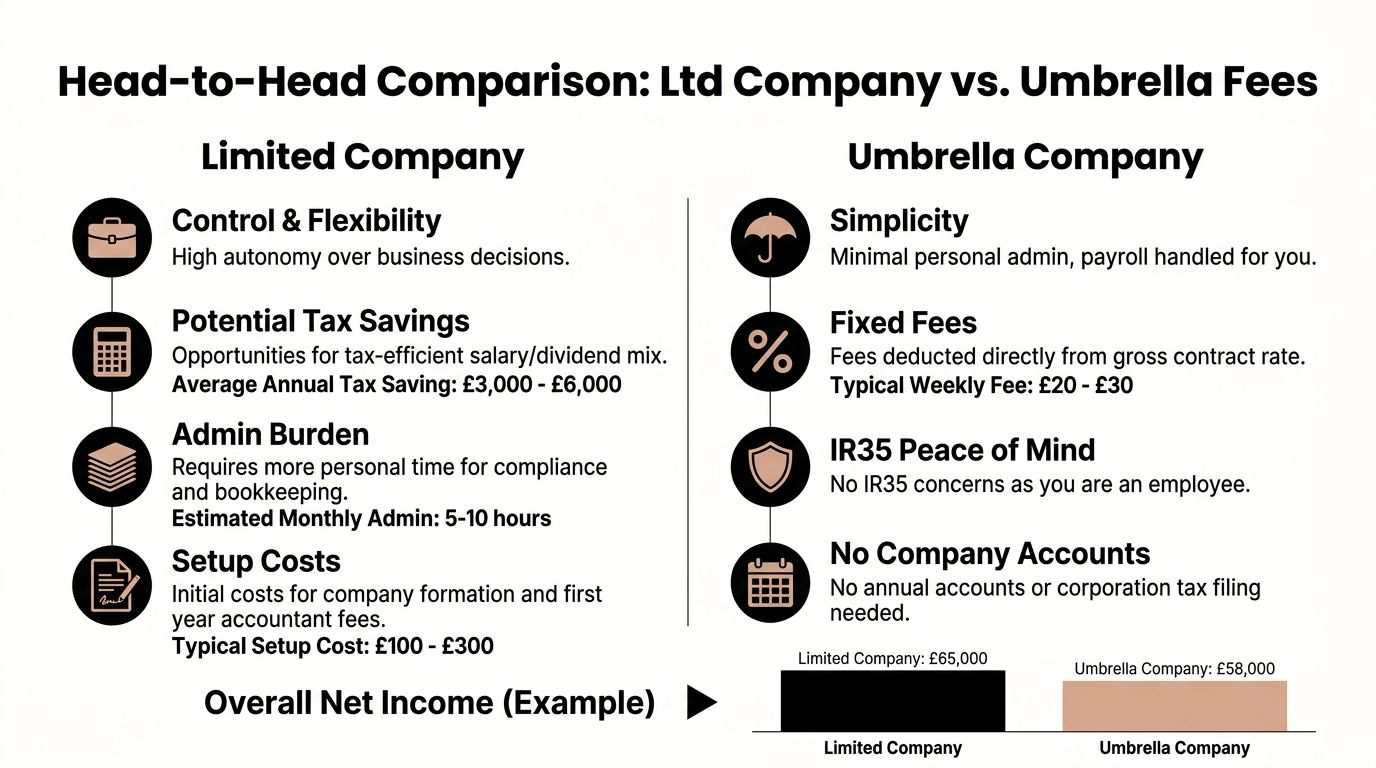
The answer depends on your contracts, your appetite for admin, and how much specialist support you need.
A limited company gives you control. An umbrella gives you simplicity.
What you are really comparing
With a limited company, the visible accountancy fee is only part of the picture. You should also think about:
- your own admin time
- software or add-on services not included in the package
- insurance and company running costs
- the effort of keeping records tidy
- the need to manage tax deadlines and filings
With an umbrella company, the structure is simpler because payroll and employment administration are handled for you. You usually give up some control, but you also remove much of the compliance burden from your own to-do list.
For a fuller decision framework, compare the two models here: umbrella company vs limited company.
When a limited company often makes sense
A limited company may suit you if:
- You work outside IR35 regularly
- You want more control over how the business runs
- You are comfortable keeping business records organised
- You value flexibility over convenience
- You are happy paying for specialist advice when needed
When an umbrella may be the better fit
An umbrella often appeals when:
- Most or all of your work sits inside IR35
- You want payroll and tax deductions handled for you
- You do not want to manage company filings
- You prefer a more employee-like setup
- You want to reduce admin quickly
Questions to ask before you choose an accountant
If you still plan to run a limited company, use these questions when speaking to accountants.
Do you specialise in contractors?
A contractor accountant should be able to explain common issues clearly, not vaguely.What exactly is included in the monthly fee?
Ask for the service list in writing.What do you charge extra for?
This often reveals the true cost.How do you support clients on IR35 questions?
The answer should be practical, not generic.Which software do you use?
It helps to know whether they work with tools like Xero or QuickBooks.How quickly do you respond to queries?
Good support is part of the value.Who will handle my account?
Sales promises and delivery are not always the same thing.
Your Checklist for Choosing the Right Contractor Accountant
A good accountant should make your company easier to run, not harder to understand.

The strongest choice is usually the firm that combines contractor experience, clear pricing, and reliable communication.
A short practical checklist
Take this list into every introductory call.
- Contractor focus: Do they work with freelancers and contractors like you every day?
- Clear pricing: Can they explain the monthly fee without vague wording?
- IR35 understanding: Can they discuss status issues in plain English?
- Software fit: Do they support the cloud tools you are willing to use?
- Communication style: Will you get answers by phone, email, or portal support when you need them?
- Scope of service: Are payroll, tax returns, and routine questions included?
- Professional credentials: Are they regulated through a recognised UK accountancy body such as ICAEW, ACCA, or AAT?
What a good answer sounds like
A strong accountant usually answers directly.
They should be able to tell you what is included, what is extra, how often they speak with clients, and what happens if your contracts or working arrangements change. If the conversation feels evasive, the service often will too.
Key takeaway: The right accountant is not just a compliance provider. They are part risk manager, part adviser, and part admin relief.
How to make the final call
If you are torn between two firms, choose the one whose service you understand better.
Price matters, but clarity matters more. A slightly higher fee with clear support, sensible boundaries, and contractor experience is often better value than a bargain package that leaves you guessing.
Conclusion Making a Smart Investment in Your Accountancy
Accountancy costs are easiest to manage when you stop treating them as a single number.
Your overall cost depends on your structure, your workload, your VAT position, and whether IR35 support is likely to matter. A simple contractor company can often stay within a modest monthly budget. A more complex setup will cost more, but the extra support may be exactly what keeps you compliant and organised.
The right choice is not always a limited company.
For some contractors, especially those who want less administration or work mainly inside IR35, an umbrella company is the cleaner option. For others, a limited company still offers the control and flexibility they want, provided the accountancy support is properly matched to the business.
If you are weighing up your next move in contracting, Umbrella Company can help you compare options and find an umbrella setup that fits your role, pay arrangement, and IR35 position.


