


So, you have set your sights on a take-home pay of £60,000 a year. It is a solid financial goal, but getting that exact amount into your bank account is more complex than it first appears. The gross salary or contract value you need to earn can vary wildly depending on how you are employed.
For a standard PAYE employee, you will likely need a gross salary clearing £85,000. If you are a contractor, the headline figure on your contract will have to be much higher to cover all the extra costs that come with the territory.
Your Realistic Guide to Earning £60k After Tax
Let's break down what it really takes to net £60k. Whether you are a permanent staffer, a contractor using an umbrella company, or running your own limited company, the deductions slicing away at your earnings will be different. Getting a handle on these is the first step to figuring out what you actually need to earn.
This guide is here to demystify the world of PAYE tax, National Insurance, pensions, and all the other deductions. We will give you a clear, upfront benchmark for different ways of working, setting the stage for the detailed calculations to come. Think of it as your practical starting point, no matter your professional setup.

Why Gross Pay Is Not the Full Story
The salary on your job offer or the day rate on your contract is the headline figure, but it is a long way from what you will actually see in your bank. A whole host of deductions come out first, and you need to know what they are to have any hope of forecasting your net income accurately.
Here are the main culprits that reduce your gross pay:
- Income Tax: This is the big one, calculated using the UK's progressive tax bands. The more you earn, the higher the percentage you pay on parts of your income.
- National Insurance Contributions (NICs): It is not just your own contributions. As a contractor, you often have to account for the employer's portion, too.
- Pension Contributions: Auto-enrolment is standard now, but any extra you choose to put in will also affect your taxable income (often in a good way).
- Student Loan Repayments: If you have one, this will be deducted automatically through payroll.
- Your Working Method: How you are set up (PAYE, umbrella, or your own limited company) completely changes which taxes and costs apply to you.
Understanding how these moving parts fit together is crucial. It is what allows you to plan your finances properly and gives you the knowledge to confidently negotiate a salary or set a day rate that actually meets your £60k net target.
This table gives a quick overview of the estimated gross salary or contract value you would need to aim for to hit that £60,000 net goal, depending on your working arrangement.
Gross Salary Required for a £60k Net Income
| Working Arrangement | Estimated Gross Salary or Contract Value | Key Deductions |
|---|---|---|
| PAYE Employee | £86,300 | Income Tax, Employee's NI, Pension |
| Umbrella Contractor | £99,500 | Income Tax, Employee's & Employer's NI, Umbrella Margin, Apprenticeship Levy |
| Limited Co. Director | £72,000 | Corporation Tax, Income Tax on salary/dividends, NI |
These are illustrative figures for the 2024/25 tax year, based on standard assumptions. Your actual figures may vary.
As you can see, the gross amount required changes dramatically. The limited company route appears most efficient on paper, but it comes with far more administrative responsibility and is not suitable for every contract (especially those inside IR35).
Different Paths to the Same Goal
For a permanent employee, the maths is fairly simple. Your employer sorts out the PAYE and NICs, and your payslip lays it all out. The main reason the gross salary is so high is that a significant chunk of your earnings falls into the 40% higher-rate tax bracket.
Contractors, on the other hand, have a much more complicated picture. If you are using an umbrella company, your assignment rate has to cover not just your pay but also the employer’s NICs, the Apprenticeship Levy, and the umbrella’s fee. This is a common point of confusion for new contractors, but it is a critical part of how compliant payroll works.
Operating through your own limited company gives you more flexibility, typically by taking a small salary and the rest in dividends. For a deep dive on that, check out our guide to the most tax-efficient contractor setup in the UK. Each option has its own tax implications, and we will walk through them all.
How PAYE and National Insurance Take a Slice of Your Salary
If you are a permanent employee, the journey from your gross salary to what actually lands in your bank account is handled by your employer through a system called Pay As You Earn (PAYE). This is simply how HMRC collects Income Tax and National Insurance from you. Getting your head around these deductions is the first real step to figuring out what you need to earn to take home that magic £60,000 figure.
Your payslip might look like a cryptic code at first glance, but it tells a very clear story. It is a breakdown of how your headline salary gets whittled down by various mandatory contributions before you see a penny.
Your Personal Allowance and Tax Bands Unpacked
Every taxpayer in the UK gets a Personal Allowance. It is the amount you can earn each year before the taxman starts taking a cut. For the 2024/25 tax year, this is a handy £12,570. Think of it as your tax-free starting block.
Once you earn more than that, you start paying Income Tax, but not all at once. The rate you pay depends on which "band" your earnings fall into. And let's be clear: to take home £60k, you will definitely be a higher-rate taxpayer.
Here is the structure for England, Wales, and Northern Ireland:
- Basic Rate: You pay 20% on earnings between £12,571 and £50,270.
- Higher Rate: You pay 40% on earnings from £50,271 up to £125,140.
- Additional Rate: Anything over £125,140 is taxed at 45%.
A common trip-up is thinking that as soon as you hit the higher-rate band, your entire salary is taxed at 40%. It is not. You only pay that higher rate on the portion of your income that actually falls into that bracket.
The Other Big Deduction: National Insurance
On top of Income Tax, you also have to pay National Insurance Contributions (NICs). This money funds crucial state benefits like the NHS, your state pension, and unemployment support. Just like tax, how much you pay is directly linked to what you earn.
For most employees (who pay Class 1 NICs), the 2024/25 rates look like this:
- 0% on the first £12,570 you earn (the same as your Personal Allowance).
- 8% on your earnings between £12,571 and £50,270.
- 2% on anything you earn over £50,270.
These two deductions, tax and NI, are the biggest players in your take-home pay calculation. If you want to get into the real nitty-gritty of the system, our detailed guide explains how PAYE works.
A Real-World Example: From Gross to Net
So, let's put it all together. To actually see £60,000 in your bank account over a year, a permanent employee with a standard tax code (1257L) would need a gross salary of around £86,300.
Here is a simplified look at where that money goes:
- Gross Annual Salary: £86,300
- Personal Allowance: £12,570 (this bit is yours to keep, tax-free)
- Total Taxable Income: £73,730
Now for the tax calculation:
- Basic Rate Tax: (£50,270 – £12,570) x 20% = £7,540
- Higher Rate Tax: (£86,300 – £50,270) x 40% = £14,412
- Total Income Tax Bill: £21,952
And let's not forget National Insurance:
- NI at 8%: (£50,270 – £12,570) x 8% = £3,016
- NI at 2%: (£86,300 – £50,270) x 2% = £720.60
- Total National Insurance Bill: £3,736.60
When you subtract all that from the gross salary (£86,300 – £21,952 – £3,736.60), you are left with a net pay of £60,611.40. Bang on target.
It is crucial to remember this calculation is a clean one. It does not factor in other common deductions like pension contributions or student loan repayments, both of which would mean you would need an even higher gross salary.
Do Not Forget Pensions and Student Loans
Pensions and student loans are the other big variables that can really change the final number.
- Auto-Enrolment Pensions: By law, you will likely be contributing 5% of your qualifying earnings into a workplace pension, with your employer adding another 3%. The good news is that your contribution is taken from your pre-tax salary, which actually lowers your taxable income and, in turn, your tax bill.
- Student Loan Repayments: If you have a student loan, the repayments are automatically deducted from your pay. How much you repay depends entirely on which plan you are on and your earnings over the repayment threshold for that plan.
How Your Pay Is Calculated Through an Umbrella Company
If you are a contractor working inside IR35, getting your head around how an umbrella company calculates your pay is one of the first hurdles. It is a different world from standard PAYE because everything starts with the assignment rate, not a simple salary.
This rate is the total amount your client or agency pays the umbrella company for the work you do. Here is the crucial bit: this single figure has to cover everything. It includes your gross pay, all the associated employment costs, and the umbrella company’s weekly or monthly margin. It is a common point of confusion, but once you grasp this, forecasting your income becomes much clearer.
What Is the Assignment Rate?
Think of the assignment rate as the all-in cost of hiring you. Before your own salary can even be worked out, a few deductions have to be made from this top-line figure. These cover the costs an employer would normally pay on your behalf.
Any compliant umbrella company will make these deductions as they are not optional. They include:
- Employer’s National Insurance Contributions (NICs): This is the big one, currently 13.8% on earnings above the secondary threshold.
- The Apprenticeship Levy: A much smaller but still mandatory deduction of 0.5% of the total payroll cost.
- The Umbrella Company Margin: This is simply the fee the umbrella charges for running your payroll and handling the admin. It is usually a fixed amount, either weekly or monthly.
- Employer Pension Contributions: The mandatory employer portion for your workplace pension.
Only after these costs are sorted does the remaining amount become your gross pay. From that point on, the deductions will look very familiar to anyone who has ever been a PAYE employee: your own Income Tax and employee National Insurance.
A Worked Example: From Day Rate to Take-Home Pay
Let's walk through a real-world scenario to see how this plays out. Imagine you have landed a contract with a day rate of £450 and you are working a standard five-day week.
- First, calculate the total assignment income: Your weekly income is £450 x 5 days = £2,250.
- Next, deduct the employment costs: From this £2,250, the umbrella first takes its margin (let's say it is £25 per week). Then, it calculates and deducts the Employer’s NI and the Apprenticeship Levy from what's left.
- This gives you your gross pay: The figure left over after all those employment costs are covered becomes your contractual gross pay.
- Then come your deductions: Your personal deductions, like Income Tax (at the 20% and 40% bands) and your own employee NI contributions (at 8% and 2%), are then worked out based on this gross pay.
- Finally, your net pay: What is left in the pot is what you take home for the week.
This multi-layered process is exactly why a high day rate is essential to hit a specific net income goal. If you want a detailed breakdown based on your own rate, you can use a payroll calculator to see your potential take-home pay.
This flowchart gives you a great visual of the journey from the gross salary figure, through all the necessary deductions, to the final net pay that actually lands in your bank account.
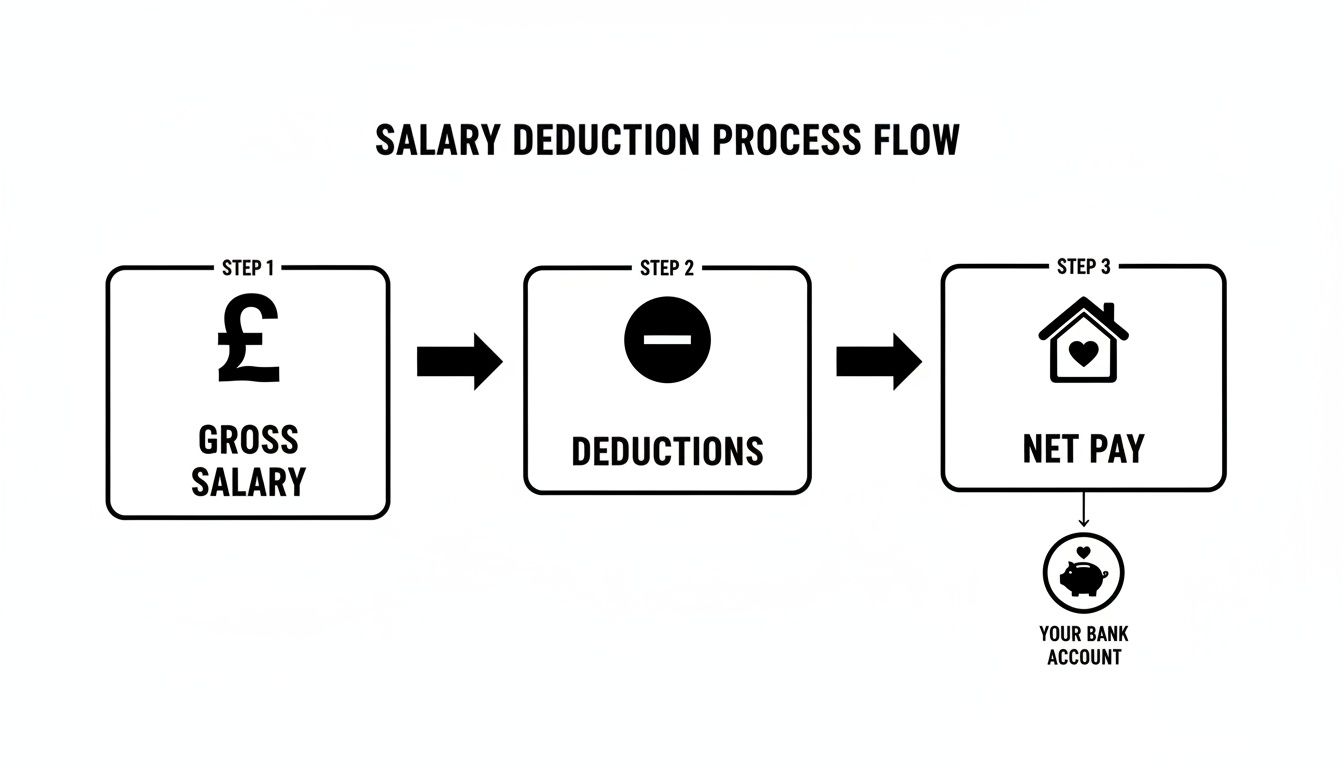
The visual really drives home that these deductions are a significant and unavoidable part of the process, directly shaping what you ultimately get paid.
Below is a sample table showing how the numbers might look on an actual payslip breakdown.
Sample Umbrella Payslip Breakdown
| Item | Calculation Example | Amount (£) |
|---|---|---|
| Assignment Income (Top Line) | £450/day x 5 days | £2,250.00 |
| Umbrella Margin | Fixed Weekly Fee | -£25.00 |
| Subtotal for Employment Costs | £2,225.00 | |
| Employer’s NI (@ 13.8%) | Calculated on subtotal | -£282.02 |
| Apprenticeship Levy (@ 0.5%) | Calculated on subtotal | -£11.13 |
| Contractual Gross Pay | Assignment less costs | £1,931.85 |
| Income Tax | PAYE Calculation | -£498.40 |
| Employee's NI (@ 8%) | NI Calculation | -£114.95 |
| Net Take-Home Pay | Gross Pay less deductions | £1,318.50 |
As you can see, the journey from a £2,250 assignment rate to a £1,318 take-home involves several key stages, with employment costs being the first and most significant reduction.
Why Your Umbrella Take-Home Is Different from a Permanent Role
We get this question all the time: "Why do I need a contract value of nearly £100,000 to take home £60k, when a permanent employee only needs a salary of around £86,000?" The answer is all about those employment costs.
In a permanent job, your employer pays their NI contributions and the Apprenticeship Levy completely separately from your stated salary. Your £86k salary is yours; their costs are an additional business expense on top of that.
When you are with an umbrella company, the assignment rate you negotiate has to absorb these costs. This is why it is absolutely vital to secure a day rate that is high enough to account for these statutory deductions. If your rate is not properly uplifted, these costs will just eat into your gross pay, making that £60k net target impossible to reach.
Getting to a £60k Net Income as a Company Director
For contractors working outside IR35, running your own Personal Service Company (PSC) opens up a completely different route to your financial target. This approach hands you the reins, offering greater control and tax efficiency, but it also brings more responsibility. The go-to strategy is blending a low, tax-friendly salary with dividend payments from company profits.
Getting this mix right is the key to hitting that £60k after tax UK figure. It is all about understanding how Corporation Tax, your dividend allowance, and personal tax bands all play together. A bit of careful planning here really pays off.

The Salary and Dividend Model Explained
When you are a company director, you wear two hats: owner and employee. This unique position lets you pay yourself in two distinct ways, a director's salary and dividends.
The classic approach involves setting your salary high enough to qualify for State Pension contributions but low enough to sidestep any significant Income Tax or National Insurance. For the 2024/25 tax year, the sweet spot is often £12,570, which lines up perfectly with the tax-free Personal Allowance.
Once all your business expenses and Corporation Tax are sorted, any leftover company profits can be paid out to you as dividends. This is generally much more tax-efficient than a large salary because the tax rates on dividends are considerably lower than income tax rates.
How Company Profits Become Your Personal Income
Before you can touch any dividends, your company has to settle its Corporation Tax bill. For the 2024/25 tax year, the main rate is 25% on profits over £250,000. If your profits are under £50,000, you will pay the small profits rate of 19%.
Let’s run through an example to see how this all fits together. To land a personal take-home pay of £60,000, your company needs to bring in a healthy profit.
Example: The Numbers Behind a £60,000 Take-Home
Let's imagine your company generates a profit of £82,000 before you have paid yourself or any taxes.
- Director's Salary: You pay yourself a salary of £12,570. As a business expense, this reduces your company's taxable profit.
- Remaining Company Profit: £82,000 – £12,570 = £69,430.
- Corporation Tax (at 19%): Your profit is under the £250k threshold, so you will pay 19%. That is £69,430 x 19% = £13,191.70.
- Profit Available for Dividends: £69,430 – £13,191.70 = £56,238.30.
Now, what does this mean for your personal tax?
- Salary: Your £12,570 salary is covered by your Personal Allowance, so no tax or NI is due.
- Dividends: You have £56,238.30 to take as dividends.
For the 2024/25 tax year, you get a tax-free Dividend Allowance of £500. The rest is taxed based on your income band.
- Basic Rate Dividend Tax (8.75%): Your first £37,700 of taxable income falls into the basic rate band. After using the £500 allowance, you will pay 8.75% on £37,200, which works out to £3,255.
- Higher Rate Dividend Tax (33.75%): The rest of your dividends (£56,238.30 – £500 – £37,200 = £18,538.30) are taxed at the higher rate of 33.75%. That comes to £6,256.55.
Your total dividend tax bill is £3,255 + £6,256.55 = £9,511.55.
So, what is your final take-home pay? It is your tax-free salary plus your dividends after tax:
£12,570 (salary) + (£56,238.30 – £9,511.55) = £59,296.75.
As you can see, this is incredibly close to our £60k target, showing your company would need to generate profits of just over £82,000 to get there.
Your Responsibilities as a Company Director
Choosing the PSC route means you are taking on a host of legal and financial duties. It is not just about clever tax planning; you have to run the company by the book.
Your key responsibilities will include:
- Managing Business Expenses: Keep meticulous records of every penny in and out. Legitimate business expenses reduce your profit, which in turn lowers your Corporation Tax bill.
- Filing Company Accounts: You are legally required to prepare and file a set of annual accounts with Companies House.
- Submitting a Company Tax Return: Every year, you will need to send a CT600 form to HMRC, detailing your company's income and calculating its tax liability.
- Personal Self-Assessment: You must also file a personal tax return to declare your salary and dividend income, and to pay any tax you owe.
While it can be incredibly rewarding, running a limited company requires discipline. It is why so many contractors decide to work with a good accountant as they handle the compliance side, leaving you free to focus on your work.
How to Find a Compliant Umbrella Company
Getting that £60k after tax is a great goal, but it is only achievable if you work with a legitimate, compliant umbrella company. The right partner makes sure you are paying the correct tax and National Insurance, giving you proper employment rights and total peace of mind. The wrong one could leave you facing a hefty HMRC bill down the line.
Making an informed choice has never been more critical. As the contracting market has grown, so have the number of dodgy operators. You need to know how to sift the trustworthy partners from the risky schemes.
Start with Accreditation
When you begin your search, the very first thing to look for is accreditation from a recognised professional body. In the UK, the two names that really matter are the FCSA (The Freelancer & Contractor Services Association) and Professional Passport.
These organisations are the industry’s watchdogs. They carry out intense, independent audits to make sure their members are playing by the rules and meeting the highest standards. Seeing their logo is a good sign.
- FCSA Accreditation: This seal of approval means an umbrella has passed a rigorous audit covering everything from their contracts to their payroll processes.
- Professional Passport Approval: Similarly, this accreditation shows a provider has been thoroughly vetted and is compliant with all the relevant legislation.
Honestly, choosing an accredited provider is the single best move you can make to protect yourself. It is a clear signal that the company is serious about operating ethically and transparently.
Spotting the Red Flags of a Dodgy Scheme
Unfortunately, the market is littered with operators pushing tax avoidance schemes. They often dress them up to look like legitimate payroll services, but they can land you in serious trouble with HMRC. Knowing the warning signs is your best defence.
The explosion of umbrella companies after the IR35 reforms has made it much harder to hit a target like £60,000 net. HMRC estimated that around 700,000 workers used an umbrella in the 2022/23 tax year. At the same time, they calculated that £500 million in tax was lost to disguised remuneration schemes, almost all run by non-compliant umbrellas.
A compliant umbrella running standard PAYE will typically deliver a take-home pay of around 55–65%, depending on your tax code and pension contributions. So, be wary of anyone promising the earth.
Here are the most common red flags to watch out for:
- Promises of Crazy High Take-Home Pay: If an umbrella claims you can keep 85-90% of your earnings, run a mile. Compliant PAYE payroll just does not work like that.
- Talk of 'Loans' or 'Annuities': A classic trick of disguised remuneration is to pay you part of your income as a non-taxable 'loan'. These are not genuine loans, and HMRC sees them as straight-up tax avoidance.
- Confusing Payslips: Your payslip should be crystal clear. It must show the assignment rate, all employment costs, your gross pay, and every single deduction. If it is vague or you cannot make sense of it, start asking tough questions.
- Offshore Bank Accounts: If your money is being funnelled through an offshore company or trust, that is a massive red flag for a non-compliant scheme.
If an offer sounds too good to be true, it is. HMRC is very clear on this: the responsibility for unpaid tax ultimately lands on you, the individual. Pleading ignorance will not work as a defence.
Doing Your Own Due Diligence
Beyond checking for accreditations and red flags, there are a few final checks we would always recommend before you sign anything. A few minutes of extra work now can save you a world of pain later.
First, get a clear breakdown of their margin. Is it a fixed weekly or monthly fee? A compliant umbrella will be totally upfront about this as it is the only money they should be making from your contract. Avoid any provider that charges a percentage-based fee as it is just not best practice.
Next, do a bit of digging online. Check their history on Companies House and search for reviews from other contractors. A company that has been around for a while with a solid reputation is always a much safer bet. To give you a head start, our guide on choosing the best umbrella company in the UK has already vetted some of the top providers.
Finally, do not be afraid to ask direct questions. A reputable provider will happily walk you through their calculations and give you a detailed pay illustration. If they get defensive or cannot give you a straight answer, walk away. Your financial security is too important to take a chance on.
Contractor FAQs: Hitting Your £60k Net Pay Goal
When you are aiming for a specific income target like £60,000 after tax, a lot of questions pop up. It is completely normal. To help you navigate it all, we have answered some of the most common queries we get from contractors.
Think of this as a quick-fire round to reinforce the key takeaways from the guide, giving you the clarity needed to make your next move with confidence.
How Do Pensions Affect My Calculations?
Pension contributions are a game-changer, especially when made through salary sacrifice. This simple mechanism can seriously improve your net pay position. When you contribute this way, the money is taken from your gross pay before any tax or National Insurance is deducted.
The result is that your taxable income is lower, meaning you pay less tax. For anyone shooting for a £60k net income, this is a powerful tool. A smaller chunk of your earnings will tip into the higher-rate tax band, which ultimately reduces your overall tax bill and makes that target just a little bit easier to hit.
Umbrella or Limited Company for This Income Level?
Choosing between an umbrella company and your own limited company (a PSC) is one of the biggest decisions you will make. When you are aiming for a £60k net income, the right choice really boils down to your IR35 status and how much admin you are prepared to handle.
- Umbrella Company (Inside IR35): If your contracts are inside IR35, this is the most straightforward and compliant path. All your tax and NI contributions are sorted for you, giving you peace of mind and statutory employment rights. It is the "set it and forget it" option.
- Limited Company (Outside IR35): If you are genuinely operating outside IR35, this route is usually more tax-efficient. By taking a smaller salary and the rest in dividends, you can often reach that £60k net figure with a lower overall contract value. The trade-off is that you are a company director, with all the responsibilities and accountancy costs that come with it.
For most contractors, the decision comes down to risk versus reward. An umbrella offers a hassle-free, compliant way to get paid. A PSC gives you more financial control but demands more of your time for admin and legal duties.
How Do I Set My Day Rate for a £60k Net Target?
Setting your day rate is not just about picking a number you like the sound of. To reliably hit a £60,000 net income, you need to work backwards from your goal, accounting for all the deductions we have talked about.
Start with your £60k target. Now, add back your estimated annual tax, both Employee's and Employer's National Insurance (a must if you are using an umbrella), your pension contributions, and any umbrella company fees. Once you have that total gross figure, just divide it by the number of days you realistically expect to work in a year. A good baseline is around 220-230 days, which accounts for holidays and potential downtime. That final number is the minimum day rate you need to charge.
At UmbrellaCompany.com, our entire focus is on helping contractors find the perfect, compliant payroll solution for their needs. Our free comparison tool makes it simple to compare trusted providers and get started.


