


So, you have set your sights on a take-home pay of £40,000 a year. It’s a solid goal, but what does that mean in terms of the gross salary or day rate you need to achieve? This guide explains what you need to earn to hit that target, whether you are a permanent employee or a contractor.
For a standard employee on a company payroll, you will need to earn a gross salary of around £54,500 to see £40,000 land in your bank account. However, if you are a contractor, the picture looks quite different, as the gross figure needs to be higher to cover various employment costs.
What Gross Income Do You Need For £40,000 After Tax?

Figuring out the gross income needed to net £40,000 is the crucial first step in your financial planning, whether you are a permanent employee or a seasoned contractor. The journey to that target net pay is not a one-size-fits-all path; your employment status completely changes the calculations.
For someone on a standard PAYE contract, it's quite straightforward. Your employer handles the deductions for Income Tax and National Insurance Contributions (NICs) before your salary ever hits your account.
Things get more complex for contractors, especially if you work through an umbrella company. The 'assignment rate' you agree with your client has to cover a lot more than just your take-home pay.
Key Factors Influencing Your Gross Pay Requirement
A handful of variables will determine the exact gross income you need to hit your target. These can easily shift your required earnings by thousands of pounds a year, so it is essential to understand them.
The main deductions to watch out for are:
- Income Tax: Calculated based on the UK tax bands.
- National Insurance: Both employee and employer contributions come into play.
- Pension Contributions: Any personal contributions you make will reduce your taxable income.
- Employment Costs (for contractors): If you use an umbrella company, your rate needs to cover their margin, Employer’s NI, and the Apprenticeship Levy.
For a UK contractor wanting to clear £40,000 after tax through an umbrella company, the magic number is the gross "assignment rate" you need to charge. To achieve this, most contractors will need a total assignment rate somewhere in the region of £55,000 to £60,000 per year before any deductions.
To give you a clearer picture, here is a quick comparison of the gross annual income you would likely need across different setups.
Estimated Gross Annual Income Needed For £40,000 Net Pay
| Employment Type | Estimated Gross Annual Income | Key Considerations |
|---|---|---|
| PAYE Employee | £54,500 | Employer covers all employment costs (Employer's NI, pension, etc.). |
| Umbrella Contractor | £58,000 | Rate must cover Employer's NI, Apprenticeship Levy, and umbrella margin. |
| PSC Contractor (Outside IR35) | £47,000 | Assumes salary/dividend mix; responsible for own taxes and costs. |
As you can see, your employment structure makes a significant difference to the gross income you need to generate.
Getting your potential earnings calculations right is absolutely vital. A simple miscalculation can leave you with an unexpected shortfall and throw your financial plans off course. Always use reliable tools to get a clear, accurate picture of what you will actually take home.
To see exactly how these deductions would affect your earnings in different situations, pop your details into our take-home pay calculator. It gives you a personalised illustration with a full breakdown based on your specific rate and circumstances.
In the next sections, we will walk through some worked examples to give you even more clarity on how it all adds up.
Understanding What Comes Off Your Pay Before You Get It

It can be a bit of a shock seeing your gross pay shrink before it ever hits your bank account. To really understand what you need to earn to take home £40,000, you first have to understand the deductions that turn a healthy gross figure into a much smaller net amount.
These deductions are not random; they are all part of the UK’s Pay As You Earn (PAYE) system. Every payslip tells a story, and the two main characters are always Income Tax and National Insurance Contributions (NICs). They are the biggest deductions for almost every worker in the UK, whether you are a permanent employee or a contractor working through an umbrella company.
Income Tax: The Biggest Deduction
Income Tax is how the government primarily funds public services. It is not a flat rate; it is a progressive system based on tax bands. This simply means you only pay a certain percentage on the slice of your earnings that falls into each band.
For the 2024/25 tax year in England, Wales, and Northern Ireland, here is how the bands are structured:
- Personal Allowance: You do not pay a penny of tax on the first £12,570 you earn.
- Basic Rate: On earnings between £12,571 and £50,270, you will pay 20%.
- Higher Rate: Anything you earn between £50,271 and £125,140 is taxed at 40%.
It is worth remembering that Scotland has its own tax bands and rates, which often means the take-home pay can be different for the same gross salary. If you want to dive deeper into the details, our guide explains in detail how PAYE works, breaking the whole process down.
National Insurance Contributions
Next up, you have National Insurance Contributions, or NICs. These payments build up your entitlement to certain state benefits, most notably the State Pension. Just like Income Tax, the amount you pay is directly linked to how much you earn. As an employee or an umbrella contractor, you will be paying Class 1 National Insurance.
Your employer also has to pay Employer’s National Insurance on your earnings. This is a crucial detail for contractors using an umbrella company because this cost is deducted from your assignment rate before your own gross pay is calculated.
Your personal tax code is the key that unlocks your tax-free allowance. The standard code is 1257L, but if yours is different for any reason, it will directly affect your final pay calculation.
Finally, a few other things can reduce your pay. Mandatory workplace pension contributions will be deducted, and if you have a student loan, repayments are taken automatically once you earn over the threshold. All of these elements come together to determine your final take-home figure.
The Employee Calculation: What Salary Do You Need For £40k Take-Home?
Before diving into the world of contracting, it helps to have a baseline. Let’s look at what it takes to clear £40,000 after tax in a standard, permanent PAYE (Pay As You Earn) job. It is the most straightforward way to get paid, and understanding it makes the contractor calculations much clearer.
To hit that magic number, you would need a gross annual salary of roughly £54,500. That is the figure you would see on your employment contract. But, as we all know, a fair bit gets taken off before it ever reaches your bank account.
The first deduction is actually a positive one: your tax-free Personal Allowance. For the 2024/25 tax year, the government lets you earn £12,570 completely free of Income Tax. So, we subtract this from your gross salary to find out how much of your pay is actually taxable.
Breaking Down The Tax And National Insurance
With a £54,500 salary, your taxable income comes to £41,930 (£54,500 minus the £12,570 allowance). This amount is not just taxed at one flat rate; HMRC splits it across different tax bands.
Here is how the tax bill stacks up:
- Basic Rate: The first £37,700 of your taxable pay is subject to 20% tax. That is a deduction of £7,540.
- Higher Rate: The remaining £4,230 (£41,930 – £37,700) falls into the higher rate band, which is taxed at 40%. This adds another £1,692 to the tax bill.
Add those together, and your total Income Tax for the year is £9,232.
Of course, tax is not the only thing you have to pay. Next up are employee National Insurance Contributions (NICs). For the 2024/25 tax year, you will pay 8% on earnings between £12,570 and £50,270. On this salary, that works out to an annual NICs payment of £3,354.40.
It is worth remembering these figures assume you are on a standard 1257L tax code. Things like student loan repayments or other benefits-in-kind would change the final numbers.
Do Not Forget Your Pension
Finally, we need to account for your workplace pension. Thanks to auto-enrolment, most employees contribute something. A typical contribution is 5% of qualifying earnings. On a £54,500 salary, that is about £2,196 a year going into your retirement pot.
So, let's pull all those numbers together for the final verdict:
- Gross Salary: £54,500
- Less Income Tax: – £9,232
- Less National Insurance: – £3,354.40
- Less Pension: – £2,196
After all the deductions, you are left with a final take-home pay of £39,717.60.
As you can see, that is incredibly close to our £40,000 target. It demonstrates why you need a gross salary well over £50k just to bring home forty. Now, let’s see how this picture changes when you are a contractor.
How Umbrella Company Payroll Changes The Equation
When you work through an umbrella company, the maths for hitting a target like £40,000 after tax looks quite different. The big number you agree for a project, what we call the assignment rate, is not your taxable gross pay. It is the total pot of money the client pays for your services.
Before you even think about your personal tax and National Insurance, that assignment rate has to cover all the associated employment costs. Think of it as a single fund that pays for everything. An umbrella company must deduct costs that a permanent employer would normally pay on your behalf before it can calculate your personal deductions.
This is a very important distinction, and it catches a lot of new contractors out. The higher assignment rate is there for a reason, it reflects the extra financial responsibilities that have been passed down the chain from the end client.
Understanding Employment Costs
So, what exactly are these "employment costs"? They are simply the statutory liabilities that come with being an employee in the UK. When you sign up with a compliant umbrella company, you become their employee for tax purposes, and they take care of all this for you.
The main deductions taken from the assignment rate before your pay is processed are:
- Employer’s National Insurance: This is a big one, currently 13.8% on earnings above the threshold.
- The Apprenticeship Levy: A much smaller charge of 0.5% on the total payroll cost.
- The Umbrella Company Margin: This is the fee the umbrella company keeps for its services. It is usually a fixed weekly or monthly amount.
- Employer’s Pension Contributions: The mandatory employer slice of your workplace pension.
Only after these costs are settled do we get to your taxable gross pay. This is the figure that your own Income Tax and employee National Insurance are calculated on.
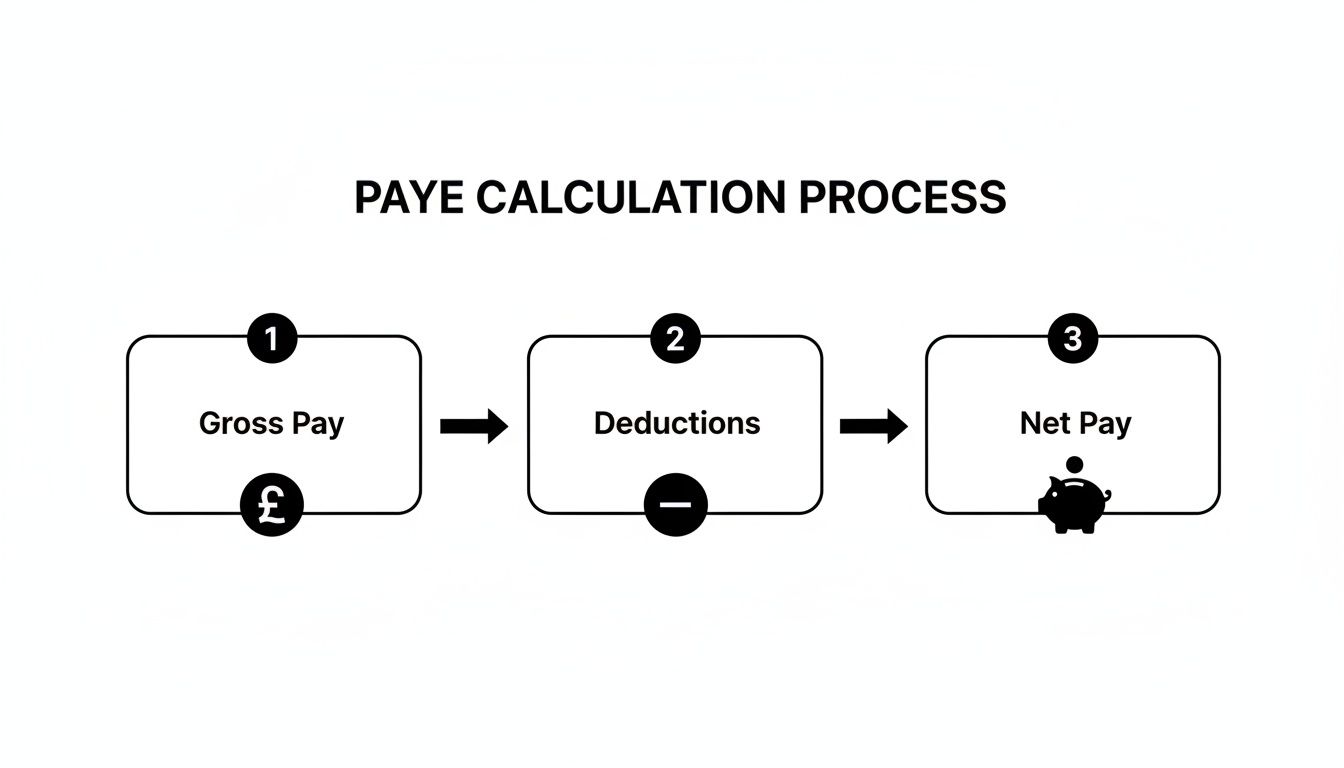
As you can see, several deductions happen before your net pay is finalised, which is why understanding the initial assignment rate is so crucial.
A Worked Example Inside IR35
Let’s put this into practice. Imagine you are a contractor on an inside IR35 project, and your goal is to take home £40,000 after tax. To do this, you would need an assignment rate of around £58,000 per year.
From that £58,000, the umbrella company first needs to deduct all the employment costs. This will be about £6,000 to cover Employer’s NI, the Apprenticeship Levy, and their margin. That leaves a taxable gross pay of roughly £52,000. It is this lower figure that is then subject to your own tax and NI.
For a more detailed look at the numbers, have a look at our guide on the key differences between umbrella employment and standard PAYE.
Before you sign anything, always insist on a full, detailed pay illustration. This document should show you the assignment rate and a complete breakdown of every single deduction. You need to know exactly what your net pay will be, with no nasty surprises.
Choosing A Compliant And Trustworthy Umbrella Partner
The umbrella company you choose has a direct impact on your financial health, so picking a compliant and trustworthy partner is absolutely critical. The market is flooded with providers, but they do not all operate with the same integrity. One wrong move could leave you with a nasty, unexpected tax bill from HMRC.
The single biggest red flag? An umbrella company promising you an unrealistically high take-home pay, like 85% or 90%. These offers almost always rely on non-compliant tax avoidance schemes, often disguised as loans or other creative payment structures to dodge proper tax and National Insurance.
Just remember the golden rule: if it sounds too good to be true, it definitely is.
Look For Professional Accreditations
To protect yourself, your first port of call should be to check for accreditations from independent, professional bodies. These organisations put their members through rigorous audits to make sure they are meeting the highest compliance standards.
In the UK, the two most respected names are:
- FCSA (The Freelancer & Contractor Services Association): Known for its incredibly strict Codes of Compliance, the FCSA is the gold standard for best practice in the industry.
- Professional Passport: This body also performs detailed compliance checks, giving you peace of mind that a provider is operating by the book.
Choosing an accredited umbrella is the most effective thing you can do to safeguard your earnings. You can learn more about finding the right fit in our guide to the best umbrella company in the UK.
Scrutinise Payslips And Margins
Once you have a shortlist, ask each one for a full pay illustration. A compliant provider will have nothing to hide and will show you a complete breakdown of every single deduction, from the assignment rate right down to your net pay. Go through this document with a fine-tooth comb.
Look for a clear, fixed margin. A typical weekly margin for a good umbrella company is usually between £15 and £25. Be very wary of providers that charge a percentage-based fee or try to sneak in hidden costs. Your payslip should clearly itemise PAYE Income Tax and Class 1 National Insurance, with absolutely no mention of loans, annuities, or anything similar.
A compliant umbrella company’s job is to make your payroll simple by ensuring you pay the correct tax and NI, just as you would as a permanent employee. They will never handle your money in a way that avoids these statutory deductions.
The umbrella sector is a massive part of the UK's flexible labour force. In fact, government research shows around 70% of umbrella employees are aged 25–54, with men outnumbering women by roughly two to one. Taking the time to find a reputable partner is not just a box-ticking exercise; it is a crucial step towards a secure and successful contracting career.
Getting to Grips With Your Contractor Pay
As you start to map out your finances, a few common questions always seem to crop up, especially when you are trying to work backwards from a target like a £40,000 take-home salary. Let's tackle some of the most frequent queries we hear from contractors.
Getting these details straight can make a massive difference in how you set your rates and manage your money day-to-day.
What Day Rate Do I Need to Take Home £40k?
This is probably the number one question we get asked: how do I turn my annual take-home goal into a realistic day rate? The simplest way to get a ballpark figure is to first figure out the gross annual assignment rate you need. As we worked out earlier, for an umbrella contractor, that is going to be somewhere around £58,000.
From there, it is just a bit of quick maths:
- Divide that £58,000 by the number of weeks you plan to work. Most contractors aim for 47 weeks, which builds in a five-week buffer for holidays, sickness, or time between contracts.
- Then, take that weekly figure and divide it by the number of days you will be working, which is usually five.
Running the numbers on a £58,000 assignment rate gives you a day rate of roughly £247. This figure is a brilliant starting point for any contract negotiation, giving you the confidence that your rate is high enough to cover all the umbrella costs and still leave you with the net pay you are aiming for.
Keep in mind, this is just a solid estimate. The final figure will shift slightly depending on your umbrella's exact margin, how much you put into your pension, and any other unique deductions. But it is a reliable benchmark to have in your back pocket.
How Does a Non-Standard Tax Code Affect My Pay?
Your tax code is basically a set of instructions for your employer (in this case, your umbrella company) on how much tax-free income you are allowed in a year. For 2024/25, the standard code is 1257L, which signals the usual personal allowance of £12,570.
But what if HMRC sends you a different one? It will absolutely change your take-home pay. A code like K100, for instance, tells your umbrella that you have extra income that is not being taxed somewhere else (like a benefit-in-kind from a previous job), so they will need to deduct more tax. On the flip side, a code like 1500T could mean you have additional allowances, which would result in less tax being taken.
It is crucial to check the tax code on your payslip and get in touch with HMRC if it looks wrong. An incorrect code can lead to you paying too much or, worse, too little tax, which can create a real headache later on.
Can I Still Claim Expenses Through My Umbrella Company?
The short answer is: not really, at least not like you used to. The rules around expenses for contractors have tightened up significantly over the last few years, especially for those working inside IR35. Since April 2016, the vast majority of umbrella contractors can no longer claim tax relief on their everyday travel and food costs for getting to a client's office.
Why? Because for tax purposes, each contract is now seen as a permanent workplace. That means your journey to and from the site is just classed as ordinary commuting, which has never been tax-deductible. While some very specific expenses might still be claimable if they are "wholly, exclusively, and necessarily" part of your job, they are few and far between.
Your best bet is to always have a chat with your chosen umbrella company to get the full picture of their expenses policy. A properly compliant provider will give you clear, HMRC-approved advice so you know exactly where you stand.
Ready to find a compliant umbrella company that is the right fit for you? At UmbrellaCompany.com, our comparison tool is the perfect place to start. In less than a minute, you can compare accredited providers based on your rate, industry, and IR35 status to make sure you get paid correctly and on time, every time.


